

LAST UPDATED
18 August 2026
Aiko Neostar vs SunPower M Class:
An Honest Comparison for South West Homes
Comparing the Aiko Neostar with the SunPower M Class? Both are premium back-contact panels with near-identical efficiency and similar installed costs.
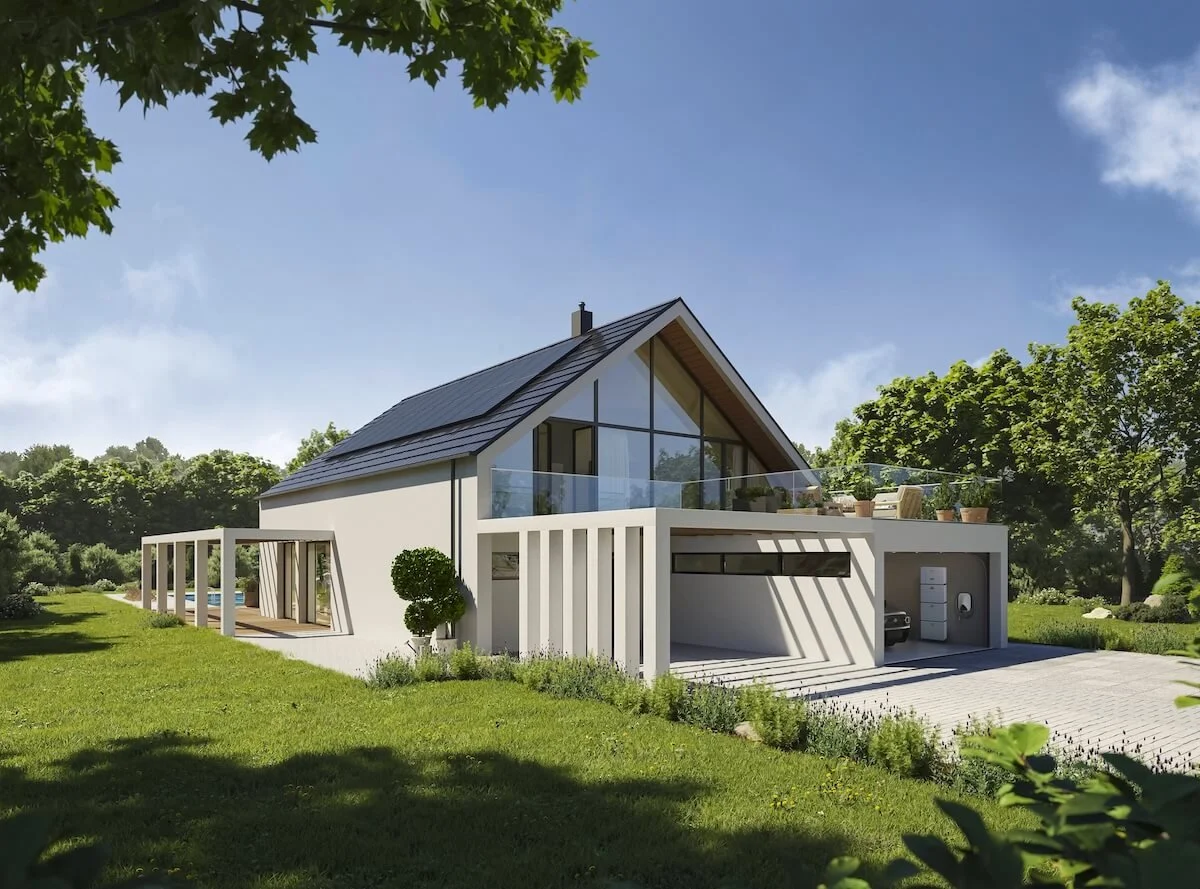
The Neostar is smaller and lighter; the M Class is warranted for 40 years against the Neostar's 30.
The right choice comes down to your roof, your location, and how long you plan to keep the system.
Why these two panels end up on the same shortlist
If you have been collecting solar panel installation quotes anywhere in the South West this year, there is a fair chance at least one of them features Aiko and another SunPower.
That is no accident. Both companies build back-contact panels, which means the cells’ electrical contacts sit on the rear rather than the front of the panel, so no silver grid lines interrupt the surface.
The result is a clean, all-black panel that converts more sunlight per square metre into electrical energy you can use in the home than conventional designs.
SunPower is the name that made back-contact technology famous, and its panels have long been the premium benchmark.
Aiko is the ambitious newcomer: a Chinese manufacturer whose ABC (All Back Contact) panels arrived in the UK with impressive specifications and keen pricing.
On paper, the two panels this guide compares – the 490W Neostar 3S54 and the 495W M Class – are separated by tiny margins. Read on to find out which is best on balance.
View our solar panelsWhere we stand
PRODUCT,
PERFORMANCE
& SERVICE
WARRANTY
Let’s be upfront. We are a SunPower Premier partner and we fit SunPower panels only: the M Class and the Performance 7 range. We don’t install Aiko. So, you should read what follows knowing where we stand, and judge it on whether we’re fair to the Neostar.
We see Aiko quotes a lot – customers bring them to us when they’re comparing – so we know the Neostar well as a rival, and there can be situations where it’s the smarter choice. This guide sets out both sides honestly, so you can make an informed decision.
“Aiko make a genuinely good panel and I’d never talk a customer out of one. But we chose to build our business around SunPower, and when someone asks what I’d put on my own roof, it’s the M Class every time. A comprehensive 40-year warranty tells you how much faith the manufacturer has in it.” – Dan Barnes, Director, Simple Solar
Aiko Neostar vs SunPower M Class: the numbers
The headline specifications below come from the two manufacturers' datasheets. We have compared the 490W mono-glass Neostar 3S54 with the 495W M Class, the versions most commonly quoted for UK homes:
 Aiko Neostar 3S54 490W
 SunPower M Class 495W
| Specification | Aiko Neostar 3S54 490W | SunPower M Class 495W |
|---|---|---|
| Rated output | 490W | 495W |
| Efficiency | 24.5% | 24.3% |
| Cell design | ABC back-contact, n-type | Back-contact, n-type |
| Construction | Mono-glass with backsheet | Glass-glass, bifacial |
| Product warranty | 30 years | 40 years |
| Performance warranty | 30 years | 40 years |
| Service warranty | n/a | 40 years |
| Warranted annual degradation | ≤ 0.35% | ≤ 0.25% |
| Temperature coefficient (Pmax) | -0.26%/°C | -0.24%/°C |
| Dimensions | 1762 × 1134 × 30 mm | 1800 × 1134 × 30 mm |
| Weight | 21.1 kg | 23.5 kg |
| Salt-spray test (IEC 61701) | Certified | Certified |
Two things stand out:
First, the performance figures are close enough that neither panel will generate meaningfully more electricity on the same roof. A few watts here, a hundredth of a percentage point there.
Second, the differences that remain are physical and contractual: size, weight, construction, and warranty. Those are the levers that should drive your decision, and they point in different directions depending on your home.
Which panel suits your home?
You have a small or complicated roof
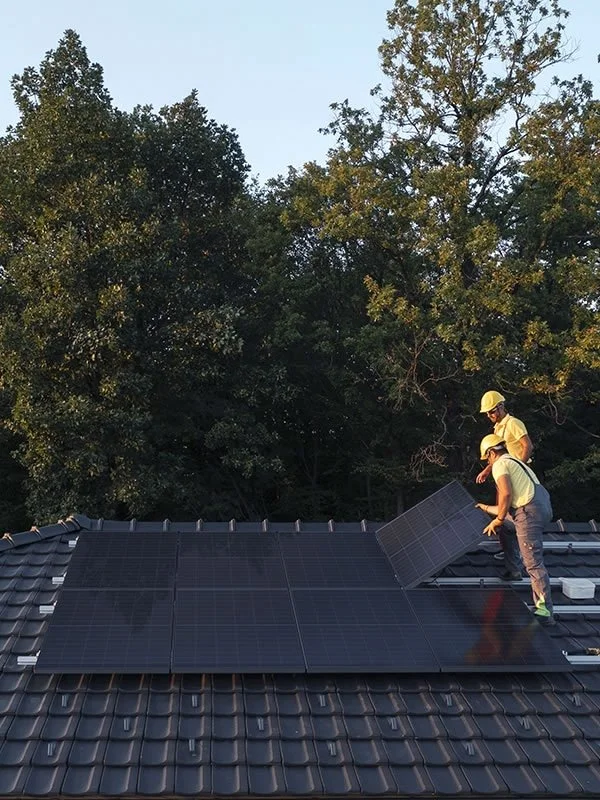
The Neostar is 38 mm shorter than the M Class and more than 2 kg lighter, and it packs 490W into that smaller frame. On a tight gable, a roof broken up by dormers and roof windows, or the hipped roofs common across the South West, that difference occasionally decides whether an extra panel fits; and one extra panel adds roughly 490W of capacity, far more than the 5W separating the two panels' ratings.
Weight can sometimes matter, too. A lighter panel is easier to handle safely on older slate roofs, which matters on the properties we work on across Plymouth, Cornwall and west Devon, though every installation gets a structural assessment at survey regardless of brand.
Your home is near the coast
A great deal of South West housing sits within a few miles of the sea, and salt-laden air is hard on everything: gutters, fixings, render, and solar hardware alike.
Start with the reassurance: both panels' current datasheets list salt-spray corrosion certification to IEC 61701, the standard test for panels installed near the sea, along with ammonia resistance to IEC 62716.
Neither should trouble a typical coastal postcode, as our solar and battery installation at Kingswear, right on the Dart estuary, shows.
For the most exposed positions – seafront, clifftop, spray zone – we still lean towards the M Class, because its glass-glass construction seals the cells between two sheets of glass rather than a polymer backsheet, and because its 40-year warranty means the manufacturer is still standing behind the panel decades from now.
You plan to stay put for decades
This is where the two panels genuinely part company.
Aiko warrants the Neostar to retain at least 88.85% of its original output after 30 years; a strong figure, and better than most panels in the market.
The M Class is warranted to degrade more slowly: no more than 0.25% a year from a 99% year-one baseline, against the Neostar's 0.35%, which works out at a guaranteed 91.75% of original output at year 30 and 89.25% at year 40.
Read that again: at 40 years old, the M Class is still warranted to produce more than the Neostar is warranted to produce at 30 years. Its cover – product and performance alike – also runs a full decade beyond the Neostar's.
If you are in your forever home, the arithmetic is straightforward: a panel guaranteed to be generating – and to be repaired or replaced if it is not under their unique ‘service’ warranty – until the 2060s is a materially different proposition from one guaranteed until the 2050s.
Your roof sees some shade
Back-contact cells generally cope with partial shading better than conventional panel designs, and both manufacturers make claims in this area – Aiko is particularly vocal about the Neostar's shading optimisation.
In practice, we find system design matters more than panel brand: where the shade falls, how the strings are laid out, and whether optimisers are worth adding. This is exactly what a site survey resolves.
What about price?
You might expect the challenger brand to undercut the premium name significantly.
For these two panels, from the competing quotes we see, it doesn’t work out that way: fully installed prices land very close to each other. Close enough that price needn’t be the deciding factor between them.
What moves the total cost of a system far more is everything around the panels: scaffolding, roof access, battery storage, and your inverter choice. If you have an Aiko quote in hand, send it to us, and we’ll price a SunPower system against it.
Explore battery storageVisual is illustrative only and does not represent fixed percentages or prices. Your quote depends on your property and chosen system.
The warranty gap: 30 years against 40
A performance warranty guarantees the panel will still produce a stated percentage of its original output at a given age.
A product warranty covers the panel itself: materials and failures. The second is the one that costs manufacturers real money, and it is where the M Class makes its boldest claim.
A quick definition, because the industry uses two different terms.
A performance warranty guarantees the panel will still produce a stated percentage of its original output at a given age.
A product warranty covers the panel itself: materials and failures. The second is the one that costs manufacturers real money, and it is where the M Class makes its boldest claim.
The Neostar carries a 30-year product and performance warranty, and, a decade ago, 30 years would have led the market comfortably. It remains a strong offer today.
The M Class carries 40 years – product, performance, and service. It’s the longest warranty on any residential panel sold in the UK. And the service component of the warranty is very unusual: it covers the cost of getting a replacement panel installed.
The warranty length outlasts a typical mortgage, most boilers two or three times over, and quite possibly the roof covering beneath it. For a purchase whose payback case is measured in decades, we think this is the single most important line on either datasheet.
The warranty length outlasts a typical mortgage, most boilers two or three times over, and quite possibly the roof covering beneath it. For a purchase whose payback case is measured in decades, we think this is the single most important line on either datasheet.
A brand-new panel from a familiar name
The M Class is newly launched, which means no one – us included – can show you a ten-year-old M Class array and its generation history.
What we can say is that the panel applies a back-contact approach SunPower has refined over decades, and that the 40-year warranty places any risk squarely on the manufacturer, rather than on you.
We will be fitting our first M Class systems as UK stock arrives this year, and we will publish measured generation figures from real South West installations as they build up.
Our Recommendation
For most South West homes, we recommend the SunPower M Class. At near-identical efficiency and similar installed cost, the decision comes down to construction and warranty. And 40 years of cover against the Neostar's 30 is, in our view, the difference that matters over the life of the system.
Choose the Aiko Neostar if roof space is tight, if an extra panel only fits at the smaller size, or if your own quote comparison puts a meaningful gap between the two in Aiko’s favour. It is a genuinely good panel, and if another installer quotes you one, that’s not a quote to dismiss.
Whichever way you lean, the right answer starts with your actual roof. A free survey settles the key factors: layout, structure, shading, and a firm price you can hold against any other quote.
Frequently asked questions
Quick answers to the questions we are most often asked about the Aiko Neostar and SunPower M Class.
Is the SunPower M Class really guaranteed for 40 years?
Yes. The M Class carries 40 years of product, power and service cover according to SunPower's datasheet, with output warranted at 91.75% of original at year 30 and 89.25% at year 40; the longest warranty term we have seen on a residential solar panel in the UK. As with any warranty, the exact terms and registration requirements are set out in the manufacturer's warranty document, which we provide with every quote.
Are Aiko solar panels any good?
Yes. Aiko is a BloombergNEF Tier 1 manufacturer, and the Neostar’s efficiency, degradation figures and 30-year product and performance warranty stand comparison with most mainstream panels sold in the UK. We don’t install them – we’re a SunPower-only installer – so treat our preference accordingly. But our reasons for choosing the M Class are about warranty length and glass-glass construction, not any weakness in the Aiko.
Which panel is more efficient?
On paper the Neostar, at 24.5% against the M Class's 24.3%, but the gap is so small it disappears in real-world conditions. Across a typical ten-panel array, the rated outputs differ by 50W in the M Class's favour (4,950W against 4,900W).
Do both panels work with battery storage?
Yes. Panel brand does not restrict your battery options. We design your system around the storage that suits your usage… – including the Tesla Powerwall, which we are certified to install – and we will model the economics with and without a battery in your quote.
Explore battery storage Tesla Powerwall →What does 'bifacial' mean, and does it matter on a roof?
The M Class is glass on both sides, so its rear face can generate from reflected light: SunPower quotes gains of 5-10% in favourable mounting conditions. On a typical UK pitched roof, with the panel sitting close to the tiles, little light reaches the rear face, so treat bifacial gain as a bonus rather than a reason to buy. The glass-glass build itself, though, is a durability advantage whatever your roof.
Will salt air near the coast damage my solar panels?
Coastal conditions are tougher on all outdoor equipment, and solar panels are no exception, which is why exposure forms part of our site survey. Both panels are salt-spray certified to IEC 61701 on their current datasheets, so neither should corrode prematurely in sea air, though we regard the M Class's glass-glass construction as the safer choice for the most exposed positions. One caution that applies to any panel: IEC 61701 is a laboratory corrosion test, not a blanket coastal guarantee, which is one more reason a proper site survey matters for seafront homes.
Will my choice of panel affect Smart Export Guarantee payments?
No. Smart Export Guarantee (SEG) eligibility depends on your installation being carried out and certified correctly – for most homes, by an MCS-certified installer – not on the panel brand. Whichever panel you choose, we handle the paperwork and your export earnings work in exactly the same way.

Book a free survey
Simple Solar designs and installs solar and battery systems across Devon, Cornwall, and Somerset.
If you are weighing an Aiko quote against a SunPower one, send us the Aiko quote, and we’ll price a SunPower system against it.
AUTHOR