
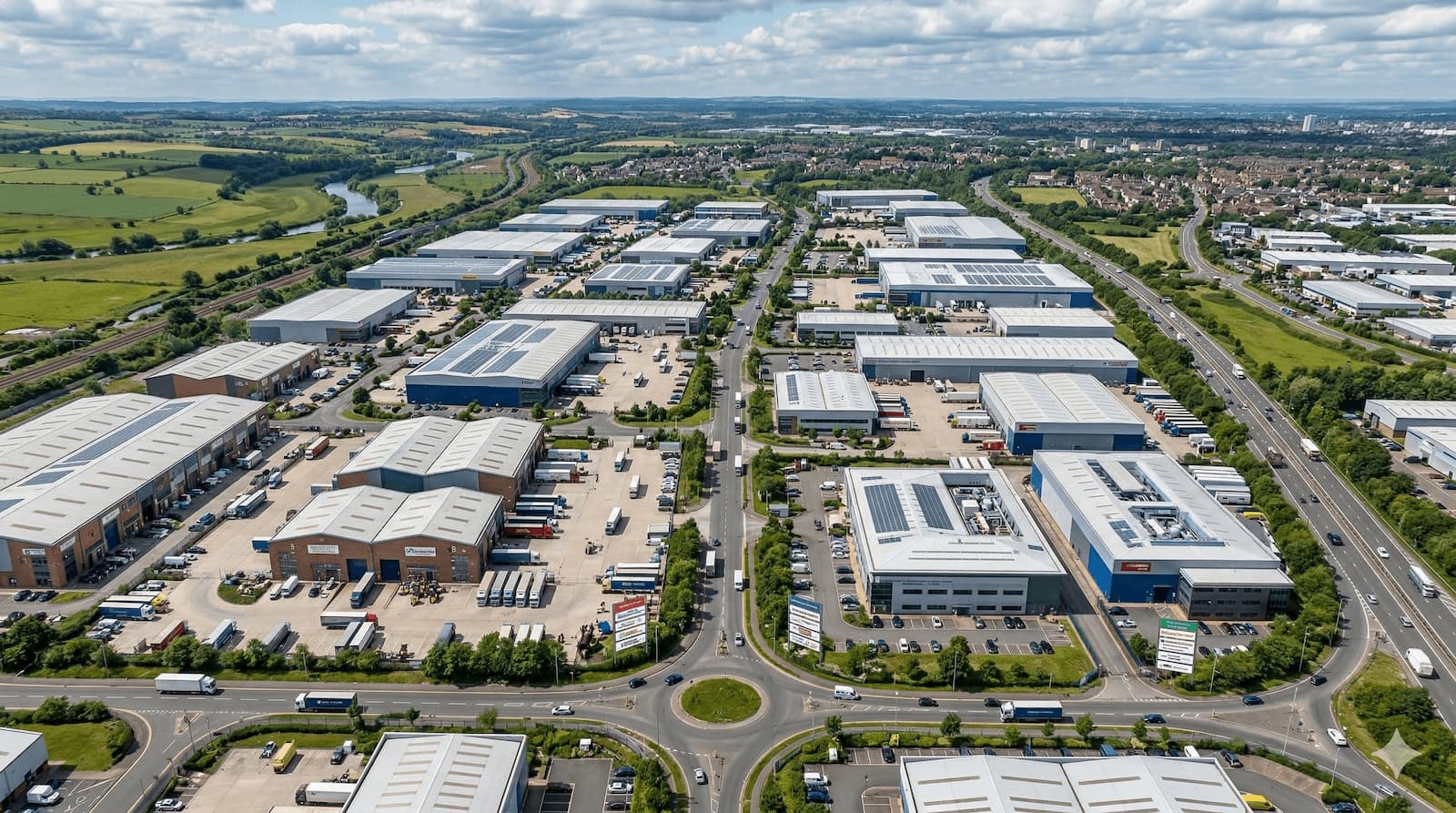
Commercial Heat Pumps for Businesses in the South-West
- Written by
- David Lewis
Renewable Energy Content Consultant - Last updated
- 14th March 2026
If you run a business from a trading estate in Devon, Cornwall, Somerset, or Dorset, there is a good chance your current heating system would benefit from an upgrade. Whether your unit relies on electric storage heaters, an ageing gas boiler, or an LPG system, commercial heat pumps offer a practical, lower-carbon alternative – and one that costs far less than you might think.
An air source heat pump does more than replace your existing heating. It gives your premises a modern, pressurised heating system with responsive temperature control across the office, kitchen, and toilet areas where your staff spend their working day. And with the government’s Boiler Upgrade Scheme (BUS) providing a £7,500 grant for qualifying commercial properties, the net cost for a typical small trading estate unit can be around £2,000.
Simple Solar is an MCS-certified installer based in Plymouth, serving businesses across the south-west. This page explains how commercial heat pumps work, what they cost, whether your premises are suitable, and how the grant process works.
 Expert installers
Table of Contents
- What Is a Commercial Air Source Heat Pump?
- Are Heat Pumps Suitable for Trading Estate Units?
- How Much Does a Commercial Heat Pump Cost?
- The £7,500 Boiler Upgrade Scheme Grant for Businesses
- Why Choose Simple Solar for Your Commercial Heat Pump?
- Benefits of a Commercial Heat Pump for Your Business
- Frequently Asked Questions About Commercial Heat Pumps
- Get a Free Quote for Your Business
Commercial ASHP
What Is a Commercial Air Source Heat Pump?
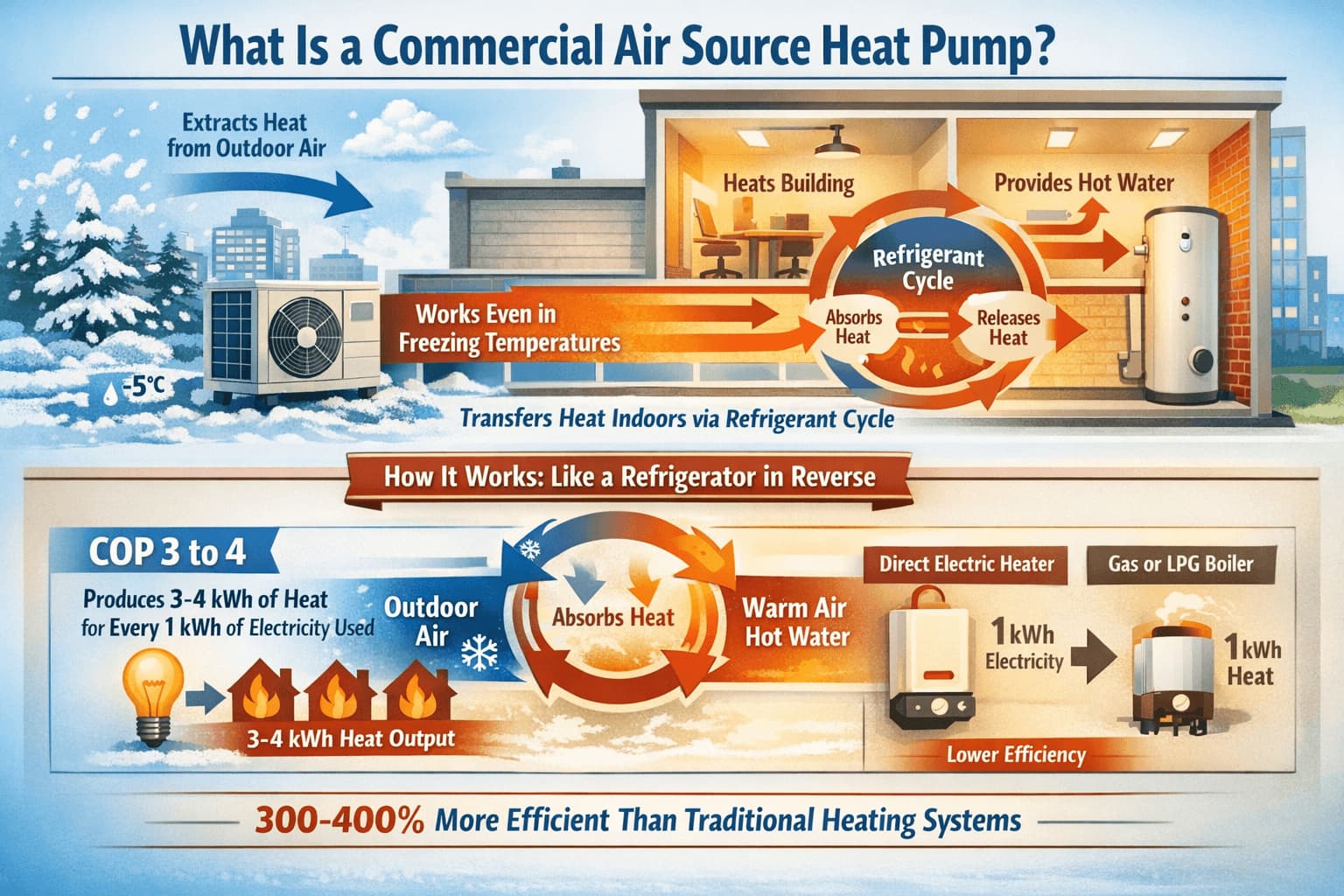
A commercial air source heat pump is an electrically powered heating system that extracts thermal energy from the outside air and uses it to heat specific areas in a building, as well as supply heat for a hot water cylinder. It works in a similar way to a refrigerator, but in reverse – absorbing heat from the outdoor air (even when temperatures drop well below freezing) and transferring it indoors via a refrigerant cycle.
The key measure of a heat pump’s performance is its ‘Coefficient of Performance’, or COP. A typical air source heat pump achieves a COP of 3 to 4, which means that for every 1 kWh of electricity it consumes, it produces 3 to 4 kWh of heat. That makes it 300-400% efficient – a significant improvement over a direct electric heater (which converts 1 kWh of electricity into just 1 kWh of heat) and considerably more efficient than a gas or LPG boiler.
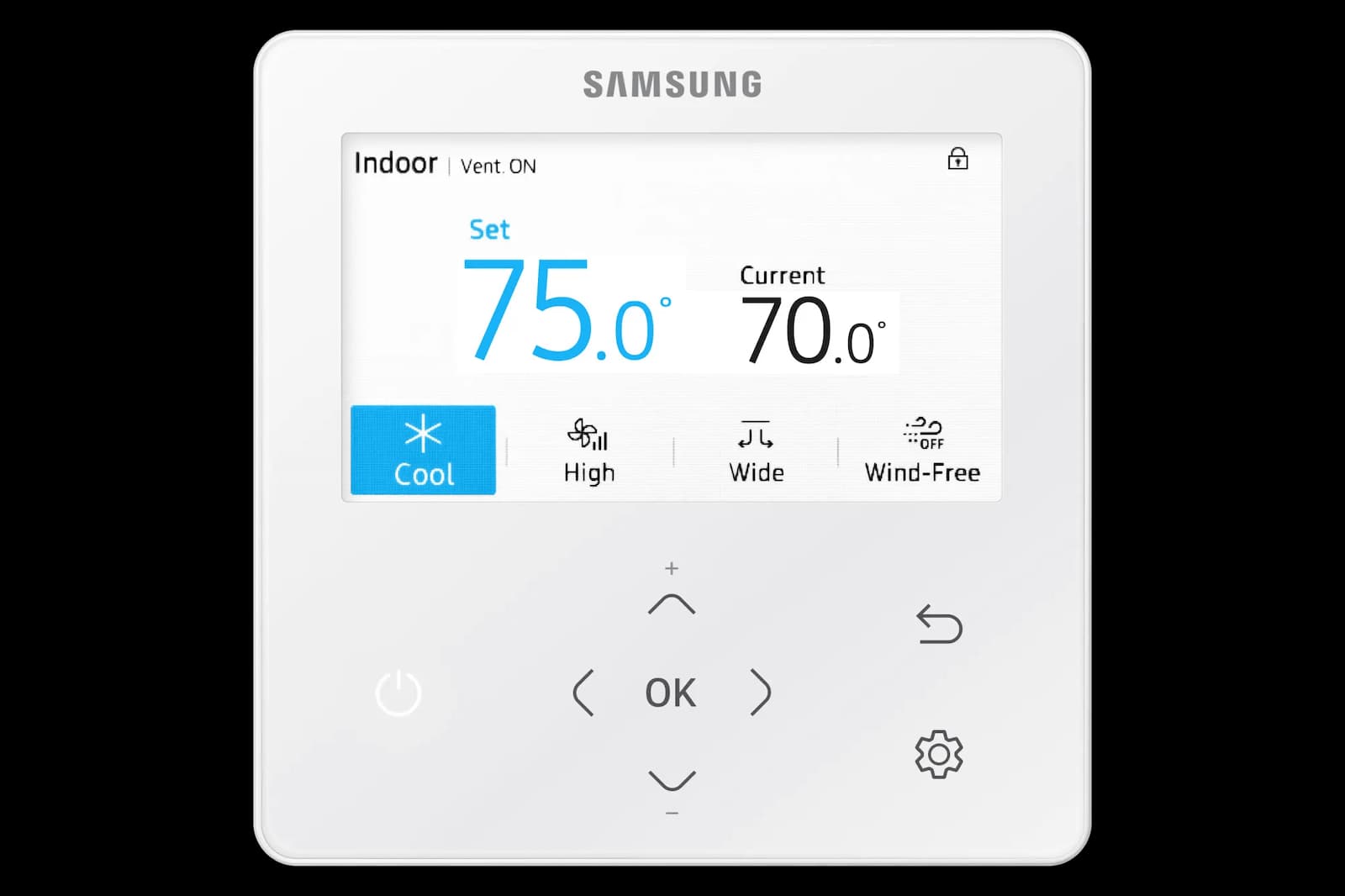
A Modern, Pressurised Heating System for Your Business
For many trading estate units, the existing heating setup is far from ideal. Electric storage heaters release heat on their own schedule rather than when you need it. Old gas or LPG boilers may be running gravity-fed or low-pressure systems that struggle to deliver consistent temperatures. In either case, staff put up with a heating system that was probably never designed for comfortable, all-day use.
Installing an air source heat pump changes this. It provides a fully pressurised heating system with responsive controls, delivering heat on demand throughout the staff areas. Temperatures are consistent, the system responds quickly to adjustment, and the overall level of comfort is a noticeable step up from what most trading estate units currently have. It is worth thinking of a heat pump not simply as a swap of one fuel for another, but as a genuine upgrade to the premises.
Commercial ASHP
Are Heat Pumps Suitable for Trading Estate Units?
In short, yes, and they are particularly well suited to the kind of small commercial premises that are common across the south-west.
A typical trading estate unit has a mix of spaces: a warehouse or workshop area, and the staff areas: the office, kitchen, and toilets. An air source heat pump is designed to heat the staff areas, providing a comfortable working environment for the people who use them every day. The warehouse or workshop is a different proposition (with higher ceilings, large doors, and very different insulation characteristics) and would need to be assessed separately if heating were required there.
For the staff areas of a small trading estate unit, the heating demand is typically well within the range of a single air source heat pump. The outdoor unit can usually be sited at the rear or side of the building, connected to radiators or underfloor heating inside. Modern air source heat pumps operate effectively at temperatures as low as –20°C to –25°C, so they are more than capable of handling the south-west’s winters.
The main requirements for suitability are adequate external space for the outdoor unit, staff areas that are reasonably well insulated (or can be improved), and a sufficient electrical supply. A site survey will confirm all of this.
Replacing Electric Heating, Gas, or LPG
Trading estate units in the south-west typically have one of three heating types, and the case for a heat pump is slightly different for each.
- Electric heating (storage heaters or panel heaters).
- This is where the case for a heat pump is strongest. Because a heat pump produces 3 to 4 kWh of heat for every 1 kWh of electricity, it is dramatically more efficient than a direct electric heater, which produces just 1 kWh of heat from 1 kWh of electricity. Businesses switching from electric heating can expect a meaningful reduction in running costs alongside a significant improvement in comfort and control.
- Gas boiler.
- Mains gas is typically cheaper per kWh than electricity, so the running cost comparison is more nuanced. A heat pump will not necessarily deliver large savings on energy bills compared to a well-functioning gas boiler, depending on the cost of gas and electricity at any given moment. However, the business gains a modern, pressurised system, a lower-carbon heating solution, no requirement for an annual gas safety certificate, and an asset with a typical lifespan of 20 years or more.
- LPG boiler.
- LPG tends to be more expensive per kWh than mains gas, which means the running cost picture is often more favourable for a heat pump. Businesses on LPG also benefit from eliminating the need for fuel deliveries and on-site storage, freeing up space and removing a logistical headache.
In all three cases, the £7,500 BUS grant substantially reduces the upfront investment.
The Importance of Insulation
Heat pumps perform at their best in well-insulated buildings. If the walls, roof, or windows of the staff areas are allowing too much heat to escape, the system has to work harder to maintain a comfortable temperature, which reduces efficiency and increases running costs.
If the staff areas of your unit are not well insulated, this does not have to be a barrier. Simple Solar can help arrange insulation improvements as part of the project, ensuring the building is ready for a heat pump before the system is installed. Better insulation also reduces the overall heating demand, which can mean a smaller – and therefore cheaper – heat pump is sufficient for the job.
Installing insulation can be very cost-effective. For example, loft insulation for a typically-sized unit would generally cost around £400-500.
Commercial ASHP
How Much Does a Commercial Heat Pump Cost?
For a typical small trading estate unit – where the heat pump serves the office, kitchen, and toilet areas – the installation cost before the grant is generally around £9,500. The exact figure depends on the complexity of the pipework, the condition of existing radiators (and whether any need upgrading), and whether any electrical work is required.
After the £7,500 Boiler Upgrade Scheme grant, the net cost for a qualifying installation is usually approximately £2,000.
That is not a misprint. Because the grant is so substantial relative to the installation cost for a small commercial premises, the out-of-pocket expense for the business owner is genuinely low. The grant is deducted directly from the final bill by Simple Solar – you don’t need to pay the full amount upfront and claim money back.
- Item
- Typical cost
- Air source heat pump installation (small trading estate unit – staff areas)
- £9,500
- Government BUS grant (deducted by installer)
- minus £7,500
- Net cost to business
- Approx. £2,000
Every installation is different. These are guideline figures for a typical small trading estate unit. A site survey will provide an accurate quotation for your specific premises.
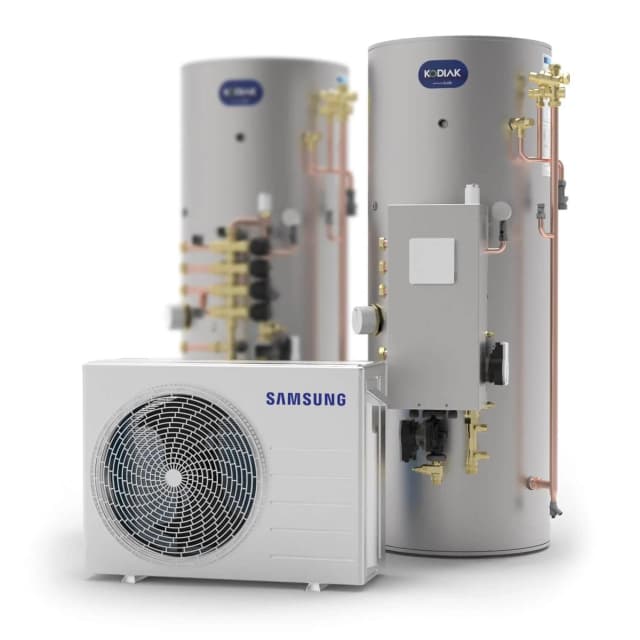
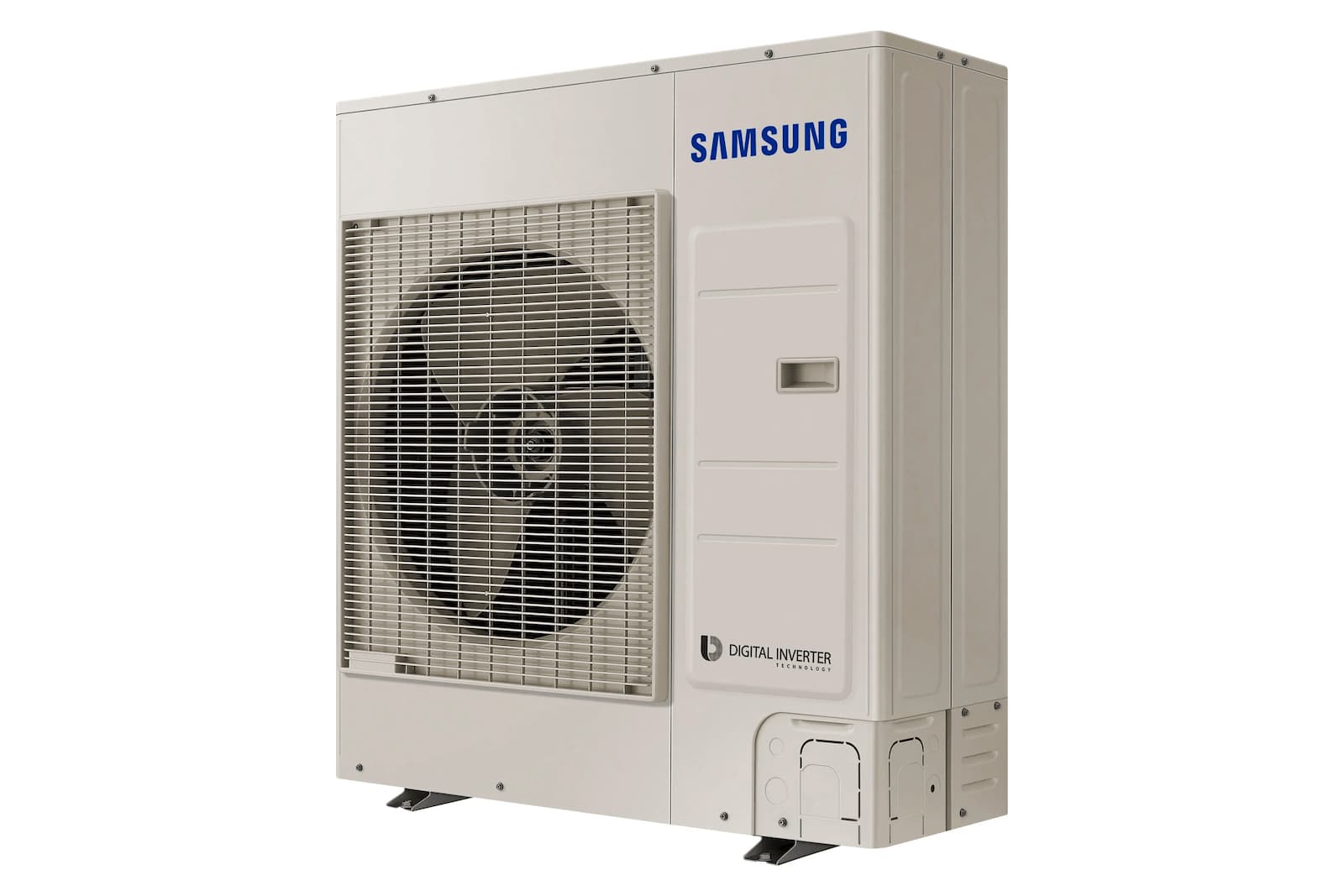
We recommend Samsung air source heat pumps for their reliability, efficiency, and performance in the UK climate. Other makes – such as Ideal Heating – can also be installed depending on the requirements of the project.
Running Costs – What to Expect
Running costs depend on the type of heating you are replacing, the level of insulation in the staff areas, your electricity tariff, and how the system is used. It would be misleading to quote a single figure that applies to every business, so here is an honest summary of what to expect.
- Electric heating
- If you are switching from electric heating, the improvement is clear-cut. A heat pump delivers 3 to 4 kWh of heat for every 1 kWh of electricity, compared to 1 kWh from a direct electric heater. You are heating the same spaces using a fraction of the electricity. For many businesses on electric heating, this represents a substantial and immediate reduction in running costs.
- Gas
- If you are switching from gas, the comparison is less straightforward. Gas is currently cheaper per kWh than electricity, so the running cost saving depends on the specific tariffs and the efficiency of the heat pump relative to the gas boiler it replaces. What you do gain is a modern, efficient system with lower maintenance costs, no annual gas safety certificate, a longer expected lifespan, and a lower carbon footprint.
- LPG
- If you are switching from LPG, the picture is generally more favourable, because LPG tends to be more expensive per unit of heat than electricity powering a heat pump.
- Solar pairing
- For any fuel type, running costs can be reduced further by pairing a heat pump with solar panels. Simple Solar installs both, so we can design an integrated system where the solar panels generate electricity to power the heat pump during the day, reducing how much electricity you buy from the grid.
Commercial ASHP
The £7,500 Boiler Upgrade Scheme Grant for Businesses
This is arguably the most important section on this page, because a surprising number of business owners do not realise they are eligible for it.
The Boiler Upgrade Scheme (BUS) is a government initiative that provides an upfront capital grant of £7,500 towards the cost of installing an air source heat pump. It is designed to help property owners replace fossil fuel or electric heating with lower-carbon alternatives, and it covers small non-domestic buildings in England and Wales; not just homes.
The heat pump system must have an installation capacity of 45 kWth or less, which covers the vast majority of eligible properties.
The process is straightforward. Simple Solar, as an MCS-certified installer, handles the entire grant application on your behalf. You do not need to fill in government paperwork or apply separately. We apply to Ofgem for the grant voucher, it is approved, and the £7,500 is deducted directly from your final bill. You see the reduced price on your quotation from the outset.
Eligibility Criteria for Commercial Properties
To qualify for the £7,500 BUS grant, your property must meet the following criteria:
- It must be a small non-domestic building in England or Wales.
- The proposed heat pump installation capacity must be 45 kWth or less. This covers the vast majority of small trading estate units.
- The property must have a valid Energy Performance Certificate (EPC) issued within the last 10 years (we can organise this for you – the cost is about £250)
- The installation must replace an existing fossil fuel heating system (gas or LPG boiler) or an electric heating system (ask us about electric heating types)
- The installer must be MCS-certified. Simple Solar holds MCS certification.
- The system must be commissioned within 120 days of the grant application.
The requirement to install loft or cavity wall insulation before claiming the grant has been relaxed. While insulating the staff areas is still recommended for efficiency, it is no longer a condition of receiving the £7,500.
Full details are available on the official GOV.UK Boiler Upgrade Scheme page and from Ofgem, which administers the scheme.
Commercial ASHP
Why Choose Simple Solar for Your Commercial Heat Pump?
Simple Solar is based in Plymouth and has been installing renewable energy systems across the south-west for years. Our founders, Ben Quick and Dan Barnes, set up the company with a straightforward aim: to make renewable energy installations simpler, more transparent, and better value for homes and businesses in Devon, Cornwall, Somerset, and Dorset.
We hold MCS certification – the industry standard for quality in renewable energy installations – and are registered with CHAS for health and safety compliance.
For commercial heat pump installations, we recommend Samsung air source heat pumps. Samsung systems are known for their reliability, quiet operation, and consistent performance in the UK climate. We can also install other makes, including Ideal Heating, depending on the specific requirements of the project.
Importantly, we handle the full BUS grant application as part of our service. You receive a quotation with the £7,500 already deducted, and we take care of all the paperwork with Ofgem. If your premises need insulation improvements before a heat pump is installed, we can arrange that too.
We also install solar panels and battery storage for commercial premises. If you are considering a heat pump, it is worth thinking about solar at the same time – the two systems complement each other, and the combination can significantly reduce the electricity costs of running the heat pump.
Our Installation Process
Free consultation and site survey.
We visit your premises to assess the staff areas, review your existing heating system, check the insulation, and determine the right size and type of heat pump for the job. The warehouse or workshop area is noted, but assessed separately – the heat pump installation focuses on the office, kitchen, and toilet areas.
Heat loss assessment.
We carry out a detailed heat loss calculation for the staff areas to ensure the system is correctly sized. An oversized heat pump wastes money; an undersized one will not keep the space warm enough.
Quotation with grant deducted.
You receive a clear, itemised quotation showing the total installation cost and the £7,500 BUS grant already deducted. No surprises.
Grant application.
Once you accept the quotation, we apply to Ofgem for the BUS grant voucher on your behalf. Ofgem will send you a short email to confirm your consent.
Installation.
For a typical small trading estate unit, installation takes 2 to 3 days. We coordinate the work to minimise disruption to your business.
Commissioning and handover.
We commission the system, walk you through the controls, and ensure everything is running correctly.
Aftercare.
We don’t disappear after the installation. Simple Solar provides ongoing support and can arrange annual servicing to keep the system running efficiently.
Commercial ASHP
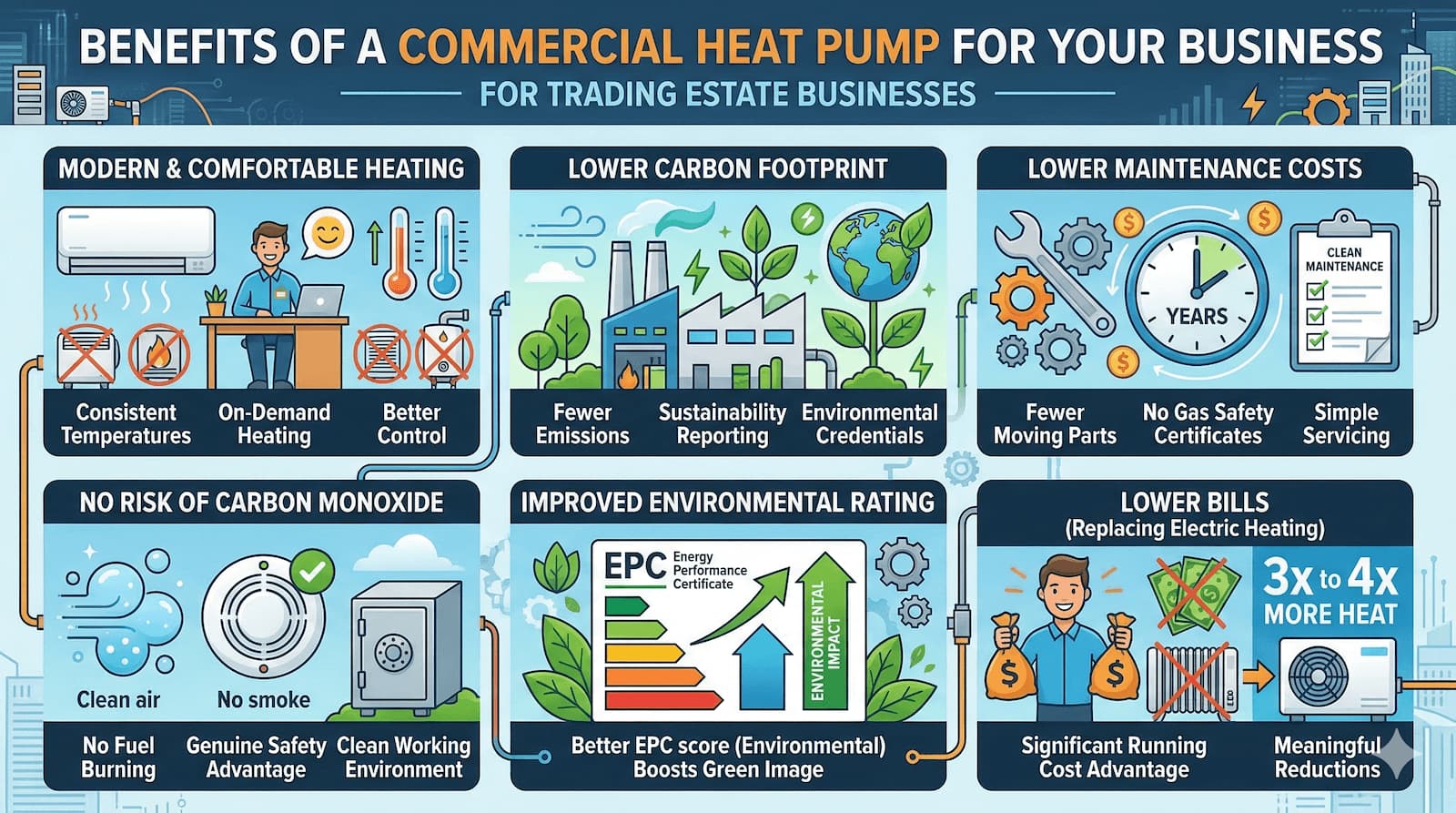
Benefits of a Commercial Heat Pump for Your Business
The benefits of switching to an air source heat pump extend beyond the energy bill. Here is what a heat pump means in practice for a trading estate business:
Commercial ASHP
Frequently Asked Questions About Commercial Heat Pumps
Can I get a grant for a commercial heat pump?
Yes. The Boiler Upgrade Scheme provides a £7,500 grant towards the cost of an air source heat pump for qualifying small non-domestic buildings in England and Wales. Simple Solar handles the entire application on your behalf and deducts the grant from your final bill.
How much does a commercial heat pump cost after the grant?
For a typical small trading estate unit where the heat pump serves the staff areas – office, kitchen, and toilets – the net cost after the £7,500 BUS grant is approximately £2,000. Every installation is different, so a site survey is needed to provide an accurate quotation.
Will a heat pump work in cold weather?
Yes. Many modern air source heat pumps can operate in sub-zero conditions, and some models are rated down to around –20°C to –25°C. They are widely used in Scandinavian countries with winters far harsher than the south-west of England, and perform reliably throughout the UK heating season.
Will it heat the warehouse as well as the office?
A commercial air source heat pump is designed to heat the staff areas of your unit: the office, kitchen, and toilets. Warehouses and large workshop areas have very different heating requirements (high ceilings, large roller doors, lower insulation levels) and would need to be assessed separately. The heat pump installation is focused on keeping the occupied areas comfortable and warm.
How long does installation take?
For a typical small trading estate unit, installation takes 2 to 3 days. We coordinate the work to minimise disruption to your business, and in most cases the staff areas remain usable throughout.
Do I need to improve my insulation first?
Better insulation helps a heat pump work more efficiently, but it is no longer a requirement for receiving the BUS grant. If the staff areas of your building would benefit from insulation improvements, Simple Solar can help arrange this as part of the project.
Will I save money on my energy bills?
It depends on your current heating type. Businesses replacing electric storage heaters or panel heaters are likely to see a noticeable reduction in running costs, because the heat pump is 3 to 4 times more efficient than a direct electric heater. For businesses on gas or LPG, the running cost comparison depends on specific tariffs and usage patterns. In all cases, you gain a modern, efficient system with lower maintenance costs and a longer lifespan than a traditional boiler.
Do commercial heat pumps require planning permission?
Planning permission is sometimes required for commercial premises. Many domestic air source heat pumps can be installed under permitted development, but larger systems and non-domestic installations sometimes need planning consent. We’ll confirm requirements during the site survey and advise you to check with your local planning authority, if required.
Commercial ASHP
Get a Free Quote for Your Business
A commercial air source heat pump gives your trading estate unit a modern, pressurised heating system for the staff areas, with the £7,500 BUS grant making the switch cheaper than most business owners expect. Whether you are replacing electric heaters, a gas boiler, or an LPG system, the result is the same: a reliable, lower-carbon heating solution designed to last 20 years or more.
Simple Solar is an MCS-certified installer based in Plymouth, serving businesses across Devon, Cornwall, Somerset, and Dorset. We handle everything – from the initial site survey and heat loss assessment to the grant application and installation.
Get a free, no-obligation quote for a commercial heat pump installation. Call us on 01752 916 013 or fill in our enquiry form to get started.
Start here
01752 916 013
Free, no-obligation quote for a commercial heat pump installation.

Author
David Lewis
Creating practical, expert content that makes solar, batteries and heat pumps clear, credible, and easy to understand.