

LAST UPDATED
25 May 2026
Heat Pumps and Solar Panels:
Do They Work Well Together?
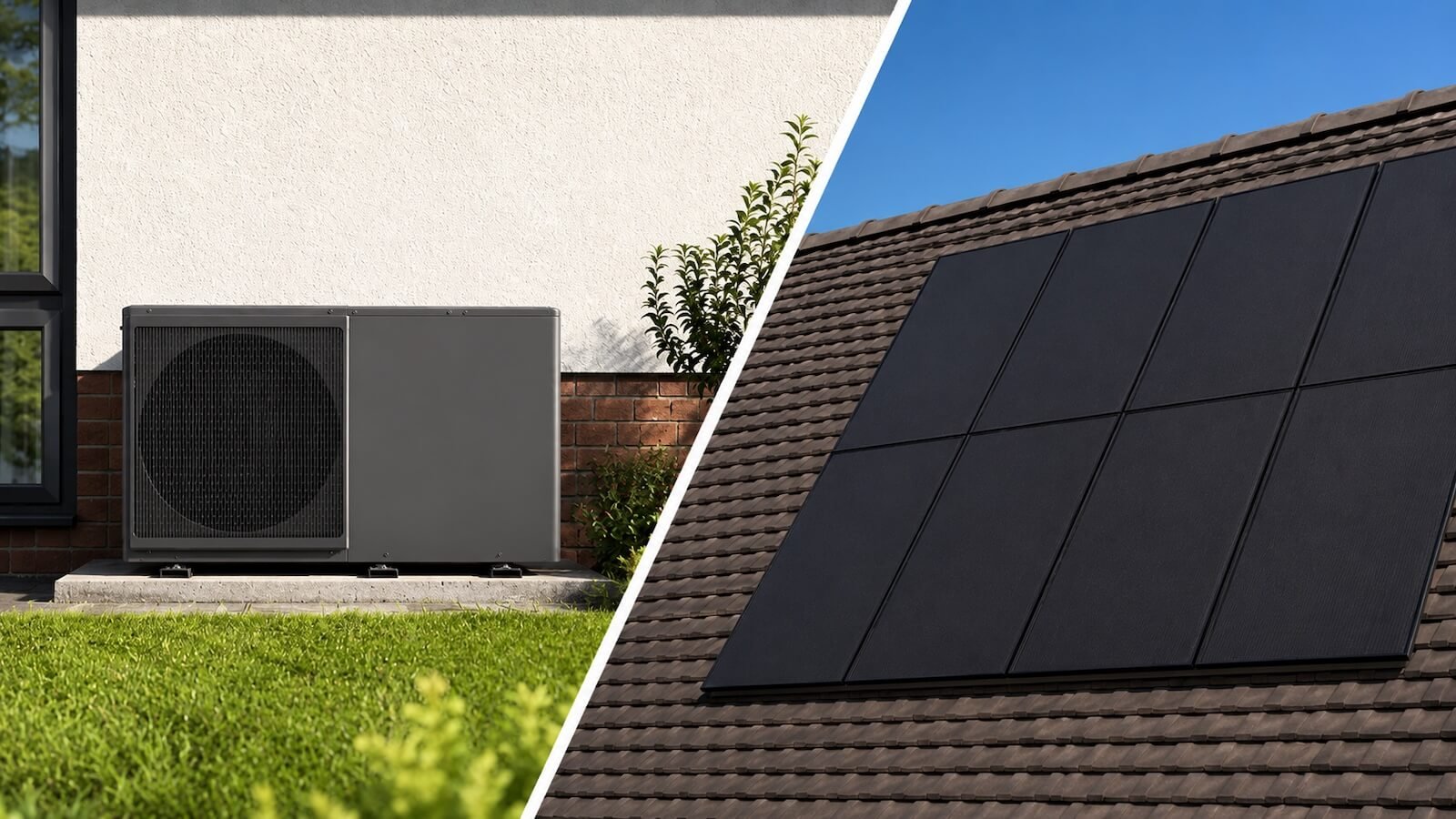
A heat pump and solar panels work well together in UK homes. The heat pump runs on electricity – solar panels generate electricity from daylight.
Combining them lowers heating bills, increases the value of every solar kWh, and remains eligible for the £7,500 Boiler Upgrade Scheme grant (£9,000 for oil and LPG properties from July 2026).

TO SOLAR

How a heat pump and solar panels work together
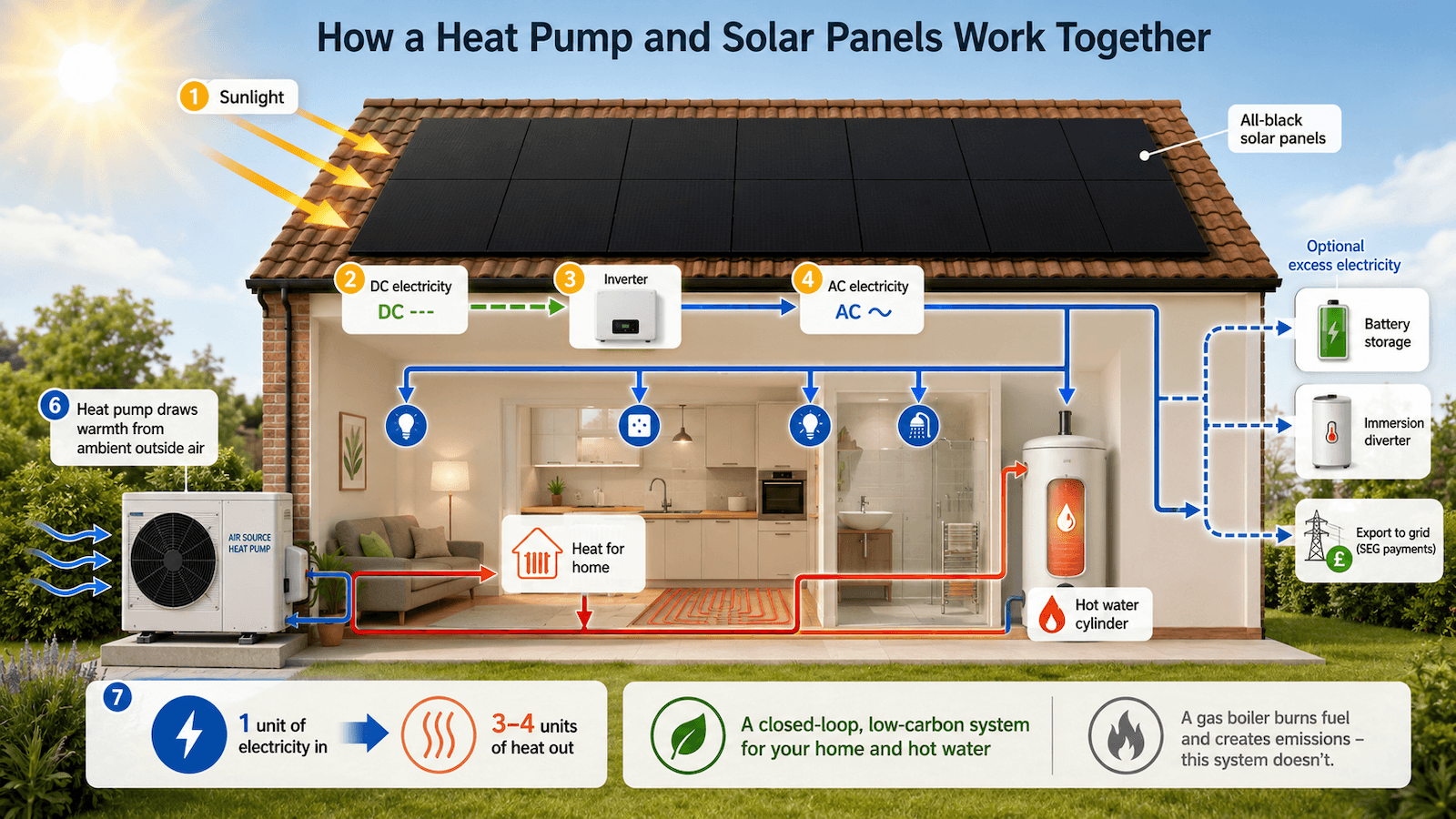
A heat pump uses electricity to move heat from outside air into your home. Solar panels generate electricity from daylight, so the two systems run as a single low-carbon heating and electricity setup.
Daylight hits the solar PV panels on your roof. The panels generate direct current (DC) electricity. An inverter converts that to alternating current (AC) that your home – and your heat pump – can use. Anything you generate but don't immediately use can be stored in a battery, run the immersion through a diverter, or export to the grid for a payment under the Smart Export Guarantee.
The heat pump, sitting outside the property, draws heat from the ambient air and upgrades it to a useful temperature inside your home and hot water cylinder. For every unit of electricity it draws, an efficient air source heat pump returns three to four units of heat. Pair that efficiency with self-generated solar electricity and you have a closed loop that no gas boiler can match.
It’s worth clarifying some terminology you might come across: a 'solar-assisted heat pump' is a specific product that couples a heat pump to a solar thermal panel acting as an evaporator. That is a niche category. Almost all UK installations are solar PV plus a standard air source heat pump – two separate products working in concert.
Is your home suitable?
Most south-west homes can take both technologies. A few practical points decide whether the combination is sensible for yours.
Roof
south, east or west aspects are ideal for solar, with minimal shading from trees, chimneys or neighbouring properties. North-facing roofs are not ruled out, but produce significantly less solar electricity.
Outdoor space for the heat pump
roughly a metre clear in front of the unit and similar above, on the side of the property where the run to your hot water cylinder is shortest. A side passage or rear garden wall is the usual location.
Indoor space
room for a hot water cylinder, usually in the airing cupboard or utility area. Unlike a combi boiler, a heat pump system typically heats your hot water in advance and stores it in the cylinder.
Insulation and emitters (e.g. radiators)
loft and cavity wall insulation in good order. Around 35% of homes in the south-west have solid walls, which can still work with a heat pump, but may benefit from radiator upgrades to compensate for higher heat loss. Heat pumps run at lower flow temperatures than gas boilers, so larger radiators or underfloor heating help them perform at their best.
Planning
most installations are permitted development. Listed buildings, conservation areas, and protected landscapes such as Dartmoor National Park, Exmoor National Park and the South Devon and Cornwall AONBs need a closer look.
A free site survey will confirm whether your specific property is a good fit. None of these factors is a deal-breaker in isolation.
How many solar panels do you need to run a heat pump?
There is no single number. A typical south-west three-bedroom home pairs a 4-6 kWp solar PV system (eight to twelve panels) with an air source heat pump sized to the property's measured heat loss. The right answer for your property depends on three things you cannot guess without a proper survey.
Your heat pump's annual electricity demand
An efficient air source heat pump in an averagely insulated three-bedroom UK home typically uses 3,000-5,000 kWh of electricity per year. The figure depends on heat loss, hot water demand, and how you set up the controls. A heat loss survey, not a rule of thumb, gives you the number that matters.
How much of that solar electricity you will actually use yourself
Even a well-sized array does not power the heat pump around the clock. Solar generation peaks in summer when heating demand is low; the two halves of the year do not line up. Realistic UK self-consumption sits at 30-50% without battery storage, and 60-80% with one.
The solar kWp size that will meaningfully contribute
For most south-west three-bedroom homes pairing a heat pump with solar, a 4-6 kWp array – eight to twelve modern panels at around 500W each – is the sweet spot. Larger arrays make sense if you have the roof space, an EV, or higher daytime occupancy.
A worked example for a typical south-west home, including brands we normally install:
A 4 kWp SunPower panel array on a south-facing Devon roof generates around 4,000-4,500 kWh per year.
The Ideal Heating Logic HP290 heat pump in the same property uses around 4,000 kWh per year.
The match looks tidy at the annual level, but the calendar matters. In June you generate far more than the heat pump needs; in January you generate a fraction of it.
The combination still works for two reasons: the heat pump uses your solar electricity preferentially during the day, and the rest comes from the grid at smart tariff rates.
That is why the number of panels is the wrong question. The right question is how the whole system fits together over a full year. A free site survey, including a heat loss assessment, allows us to put it all together for you and make a clear, logical recommendation.
How much does a heat pump and solar panel installation cost?
A combined solar and heat pump installation for a typical south-west three-bedroom home looks like this:
| Component | Price |
|---|---|
| Solar PV: 4 kWp SunPower panels | £5,500 |
| Air source heat pump: Ideal Heating Logic HP290 | £12,000 |
| Subtotal | £17,500 |
| Less Boiler Upgrade Scheme grant (fossil-fuel replacement) | −£7,500 |
| You pay | £10,000 |
These figures are guideline averages for a typical Devon three-bedroom property and include design, supply, installation, scaffolding, commissioning and MCS certification on both technologies. A site survey provides a tailored quotation for your specific home.

Two further reductions may apply.
If your home is currently heated by oil or LPG, the BUS grant is expected to increase to £9,000 from July 2026 – an additional £1,500 reduction. The uplift is set to run until 31 March 2027. That brings the typical out-of-pocket figure to £8,500 for an off-gas-grid south-west home, a meaningful saving for the many rural properties across Devon, Cornwall and Somerset on oil or LPG.
The 0% VAT relief on energy-saving materials remains in place until 31 March 2027. After that date, VAT on the heat pump returns to 5%. The table above reflects current prices.
Adding a battery widens both the cost and the value of the combined system. A Tesla Powerwall 3, installed alongside the solar array, lifts solar self-consumption from around 30% to 80% – materially improving the running-cost picture. Battery pricing depends on capacity; a tailored quote will give you the figure.
What the combined approach saves you on the project itself: a single survey instead of two; one electrical commissioning rather than two; one project relationship; one set of warranty contacts to remember. Two separate projects done six months apart would cost more for the same equipment.
Grants, tax and what you can claim
The Boiler Upgrade Scheme and 0% VAT relief between them remove a meaningful share of the upfront cost on a combined installation.
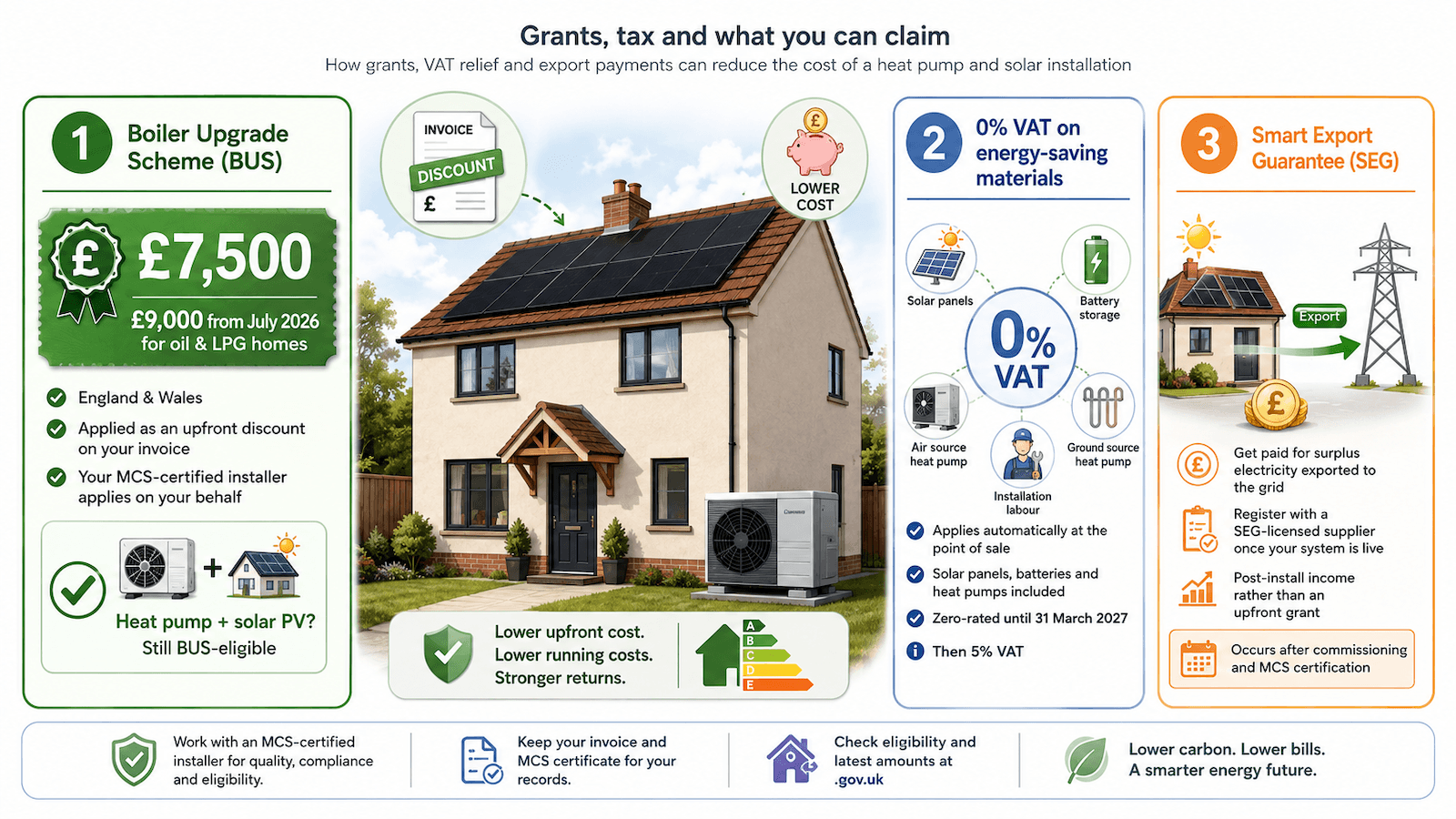
Boiler Upgrade Scheme: £7,500 (rising to £9,000 from July 2026 for oil and LPG homes)
The BUS grant covers £7,500 against the cost of an air source heat pump (or a ground source heat pump) in England and Wales. The grant is applied as an upfront discount on your invoice – you do not pay the full amount and reclaim it. We apply on your behalf as an MCS-certified installer.
A higher £9,000 grant for homes currently on oil or LPG is set to come into effect from July 2026 and run until 31 March 2027. The £1,500 uplift recognises that off-gas-grid homes – common across rural Devon, Cornwall and Somerset – face the steepest fossil-fuel running costs and the strongest case for switching. Air source and ground source heat pumps are eligible; air-to-air and biomass are not.
A point that worries homeowners more than it should: your BUS-eligible heat pump remains eligible if you pair it with a solar PV system. Ofgem's April 2026 installer guidance is explicit on the point – the solar contributes to the heat pump's electrical input and is not treated as a heat source, so the heat pump still qualifies for the grant.
0% VAT on energy-saving materials
Solar panels, batteries, air source heat pumps, ground source heat pumps and the labour to install them are zero-rated for VAT in Great Britain until 31 March 2027. After that, VAT returns to 5% (latest guidance). The relief applies automatically at the point of sale; you do not need to claim it.
Smart Export Guarantee (SEG)
Once your solar system is commissioned and MCS-certified, you can register with a SEG-licensed supplier to be paid for surplus electricity exported to the grid. The SEG is a post-install income, not a grant – it accrues quietly in the background once the system is live.
What will it actually save you?
Savings from combining a heat pump and solar panels in the UK come from three separate channels. Treating them as a single number is misleading.
Free electricity from self-consumed solar
When your panels generate electricity and your heat pump or other appliances are running at the same time, you are using free power. In summer, when heating demand is low, but generation is high, this typically covers hot water heating and most household appliances. Self-consumed solar accounts for 30-50% of household electricity without a battery, rising to 60-80% with one.
Cheap off-peak grid electricity for the rest
Heat pumps work brilliantly with smart electricity tariffs. The Cosy Octopus tariff, for example, offers three off-peak windows daily – 4am-7am, 1pm-4pm and 10pm-midnight – at roughly half the standard daytime rate.
By scheduling the heat pump's hot water cycle and the bulk of its heating output into those windows, the average price per kWh paid to the grid drops materially. Other suppliers, including EDF on its Heat Pump Tracker tariff, run similar structures.
SEG export income
Any solar electricity you generate but don't use is exported to the grid for a per-kWh payment. 12p per kWh exported is typical, but each energy supplier can choose its own rate. For a typical 4 kWp south-west system, export earnings sit around £150-£250 per year depending on the household's consumption pattern.
What does that look like in pounds?
For a typical south-west three-bedroom home switching from an oil boiler to a heat pump and adding a 4 kWp solar PV system, annual savings on heating and electricity bills sit in the £1,200-£2,000 range. The exact number for your home depends on the fuel you are replacing, your insulation, the size of your system, your tariff, and how you use the controls.
To be clear: solar will not power your heat pump around the clock in January in the UK climate. What it will do is reduce your summer hot water bill to close to zero, contribute meaningfully through spring and autumn, and chip away at the grid demand even in winter.
Plympton area homeowner
A south-west homeowner in the Plympton area replaced an ageing oil boiler with an Ideal Heating Logic HP290 heat pump and added a 4 kWp SunPower solar array in spring 2026.
Before the project, the household spent around £2,400 per year on oil and electricity.
In the twelve months following installation, total energy bills came to around £900, supplemented by £180 in SEG export income – a net annual saving of around £1,680.
Payback on the household's out-of-pocket contribution after the BUS grant: approximately six years. Figures are representative for a typical three-bedroom south-west home and will vary by property.
Living with a combined system through the year
A combined system is not a static piece of equipment. Its behaviour changes with the seasons – and your role is to set it up to take advantage of that.
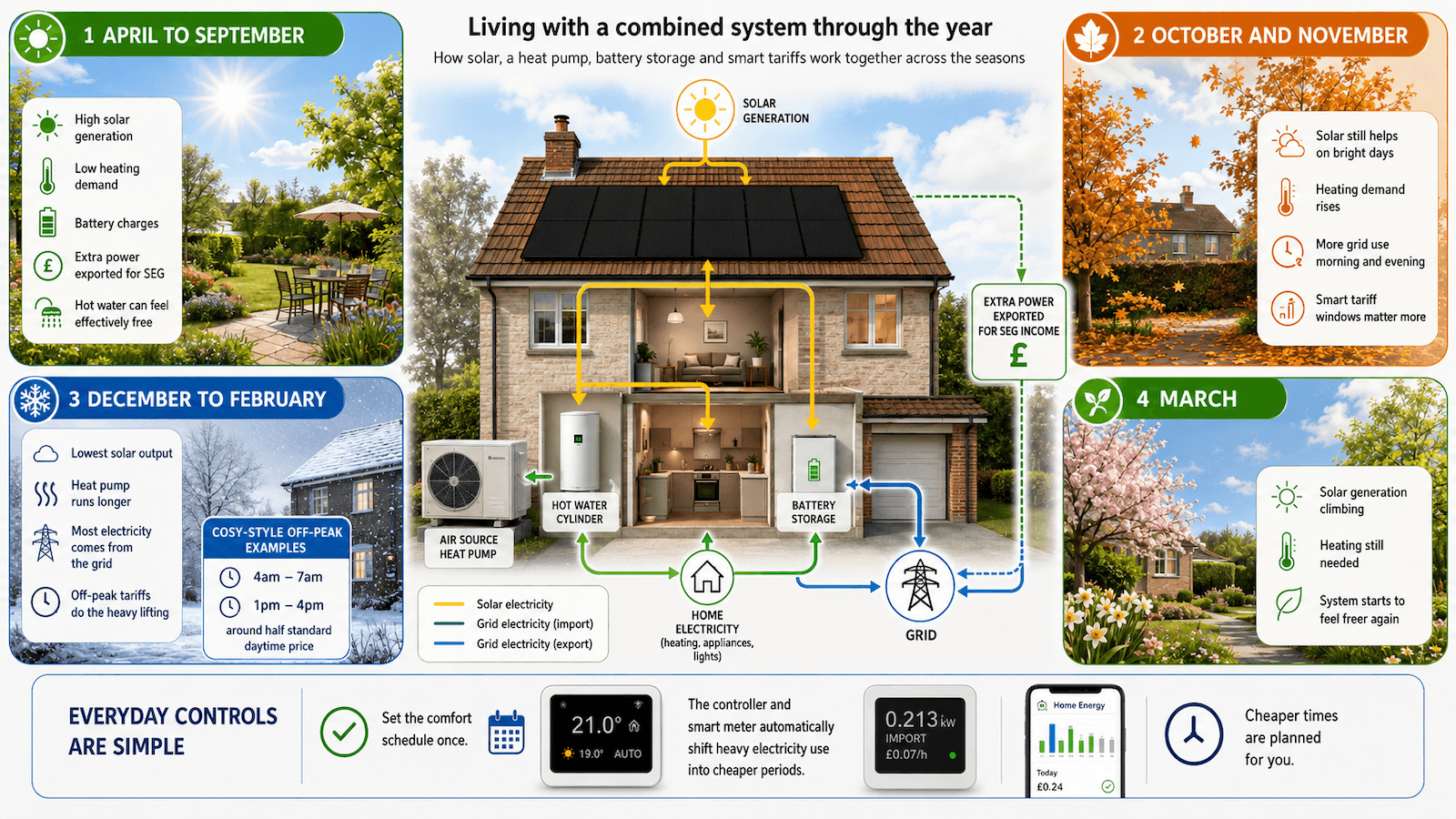
April to September: solar generation is high; heating demand is low. Your panels cover most of the household electricity and most of the heat pump's hot water work. Excess generation charges the battery (if you have one) and exports the rest for SEG income. Many homeowners describe summer hot water as effectively free.
October and November: generation tapers; heating demand rises. Solar still contributes meaningfully on bright days, but the heat pump starts drawing more heavily from the grid in the early mornings and evenings. Smart tariff windows take on more importance.
December to February: shortest days, coldest air. Solar generation is at its annual low. The heat pump runs longer hours and draws most of its electricity from the grid. This is where the off-peak tariff structure earns its keep. A well-set-up system schedules the hot water cycle into the 4am-7am or 1pm-4pm Cosy Octopus windows, where the rate is around half the standard daytime price.
March: shoulder month. Solar generation climbing; heating demand still real. The combination starts to feel 'free' again on the brighter weeks.
The everyday controls are simpler than the explanation. A modern heat pump controller, paired with a smart meter, schedules the heavy lifting into the cheapest electricity periods automatically. You set the comfort schedule once at install; the system does the rest.
Choosing an installer
Two technologies, one project. An MCS-certified installer who covers both solar PV and air source heat pumps removes a lot of friction.
MCS certification
MCS certification is the UK quality mark for small-scale renewables. It is also a necessary requirement for the £7,500 / £9,000 BUS grant and for registering your solar export with a Smart Export Guarantee supplier. An installer without MCS for the relevant technology cannot apply for the grant on your behalf.
Why MCS matters when you sell your home
When you sell a home with solar panels or a heat pump installed, the buyer's solicitor will ask for two documents during conveyancing: an MCS certificate and a Building Regulations compliance certificate. Both are produced automatically when the installation is carried out by an MCS-certified installer. If the original work was done by an unaccredited installer, those documents often do not exist, and that is where the trouble starts.
Ben Quick, Director at Simple Solar, puts it like this:

"One of the most common calls I take is from a homeowner who's putting their house on the market. The buyer's solicitor has asked for the MCS certificate and the Building Regulations paperwork for their solar panels or heat pump, and there isn't any. The original installer wasn't MCS-registered, so the documents were never issued. By the time we're on the phone, the sale is already at risk. It's completely avoidable. Always use an MCS-registered installer from day one. The grant and the export tariff matter, but the bigger reason is being able to sell your home without trouble years down the line."
Beyond the resale issue, missing Building Regulations paperwork can mean retrospective inspection or, in some cases, the system having to be reinstalled to current standards. The cost of using an unaccredited installer is rarely visible at the point of sale; it surfaces later.
Other accreditations to look for
In addition to MCS, look for membership of the Renewable Energy Consumer Code (RECC) or the Home Insulation and Energy Systems Quality Assured Contractors Scheme (HIES), and registration with TrustMark. These are the bodies that handle consumer protection on renewable energy installations.
Simple Solar credentials
Simple Solar is an MCS-certified installer based in Plymouth, covering Devon, Cornwall, and Somerset. Directors Dan Barnes and Ben Quick bring more than 40 years of combined experience in renewable heating. We hold MCS certification for solar PV, battery storage and air source heat pumps; we are RECC and CHAS registered; we are a Tesla Powerwall certified installer, and a certified SUNPOWER Premier partner.
Questions worth asking any installer before you sign a quote:
- Are you MCS-certified for both technologies on this project?
- Will one survey cover both, and one team handle both designs?
- Who is my point of contact for warranty matters after commissioning?
- Can you show me a recent combined install in my area?
A south-west view
The south-west has a structural advantage for combined solar and heat pump installations.
kWh per square metre per year in Exeter
of homes in the south-west have solid walls
Solar irradiance
Exeter receives approximately 1,237 kWh per square metre per year – around 13% above the UK national average. That difference shows up directly in your annual generation and your payback figures. A 4 kWp system in Plymouth, Newton Abbot, or Truro produces meaningfully more than the same array in the north of England.
Heating fuel mix
A significant proportion of homes in rural Devon, Cornwall, and Somerset are off the gas grid. Oil and LPG are the common alternatives, and both have seen sharp price increases. The expected £9,000 BUS grant for oil and LPG homes from July 2026 is targeted directly at this group; many south-west homes will qualify.
Housing stock
Around 35% of homes in the south-west have solid walls. Older properties – stone-built Devon longhouses, Cornish cottages, Edwardian semis in Plymouth – can take a heat pump well, but radiator sizing and insulation upgrades earn their keep. A careful heat loss survey is more important here than in newer stock.
Climate
South-west winters are milder than the UK average. Air source heat pumps perform better in milder ambient temperatures, which is a quiet advantage that does not always make it into the national guides.
The region is, on most measures, a strong fit for the combined approach.
Frequently asked questions
Quick answers on heat pumps, solar panels, grants, batteries and system sizing.
Can solar panels actually power a heat pump in the UK?
Yes, in part. Solar panels and a heat pump work well together in the UK, but solar will not cover the heat pump's electricity needs year-round. In summer your panels typically cover most of the heat pump's work; in winter the grid covers most of it. Across a full year, the combination cuts heating and electricity bills materially.
How many solar panels do I need to run a heat pump in a south-west home?
A typical south-west three-bedroom home pairs an air source heat pump with a 4-6 kWp solar array – eight to twelve modern panels. The exact number depends on your roof, your heat loss, your daytime occupancy and whether you add a battery. A site survey gives the answer for your specific property.
Do I need a battery if I have a heat pump and solar panels?
A battery is not essential, but it materially improves the value of both technologies. Without one, solar self-consumption typically sits at 30-50%; with a battery sized to the system, it rises to 60-80%. Whether the extra capital cost is worth it depends on your usage pattern and your chosen tariff.
Can I claim the £7,500 Boiler Upgrade Scheme grant if I already have solar panels?
Yes. Ofgem's April 2026 installer guidance explicitly confirms that heat pumps integrated with solar PV remain eligible for the £7,500 BUS grant. The solar contributes to the heat pump's electricity input; it is not treated as generating heat. Existing solar does not disqualify you.
Is there a 'solar heat pump'?
Not in the everyday UK sense. A 'solar-assisted heat pump' is a specific product category that couples a heat pump to a solar thermal collector acting as an evaporator. It is niche. Almost all UK installations are solar PV plus a standard air source heat pump – two separate products working in concert.
Will my heat pump work in winter when the solar panels generate less?
Yes. The heat pump runs on electricity regardless of where that electricity comes from. In winter, with solar generation at its annual low, the heat pump draws from the grid. A smart tariff such as Cosy Octopus, with three off-peak windows daily, keeps winter running costs manageable.
Is it cheaper to install solar panels and a heat pump at the same time?
Yes, by a meaningful margin. A single survey covers both designs; one scaffolding visit serves both jobs; one electrical commissioning covers the whole system; one project relationship, one warranty point of contact. Two separate projects done six months apart cost more for the same equipment.
What size heat pump and solar PV system do I need for a three-bedroom Devon home?
Indicative figures only: a 5-7 kW Ideal Heating Logic HP290 air source heat pump paired with a 4 kWp SunPower Performance solar array suits a typical south-west three-bedroom property with reasonable insulation. The correct size for your home comes from a heat loss survey – every property is different.








Ready to talk to us about a combined system?
A free site survey is the best way to find out what a combined heat pump and solar panel system would do for your home and your bills.
Our team will assess your property, design the right setup for it, and walk you through the figures – including grant eligibility and a tailored payback estimate.
Call us on 01752 916 013 or fill in our enquiry form for a free, no-obligation quote.
- Property assessment
- Heat loss review
- Solar PV suitability
- Grant eligibility
- Tailored payback estimate
AUTHOR