

LAST UPDATED
19 May 2026
Solar Panel Installers in Newton Abbot
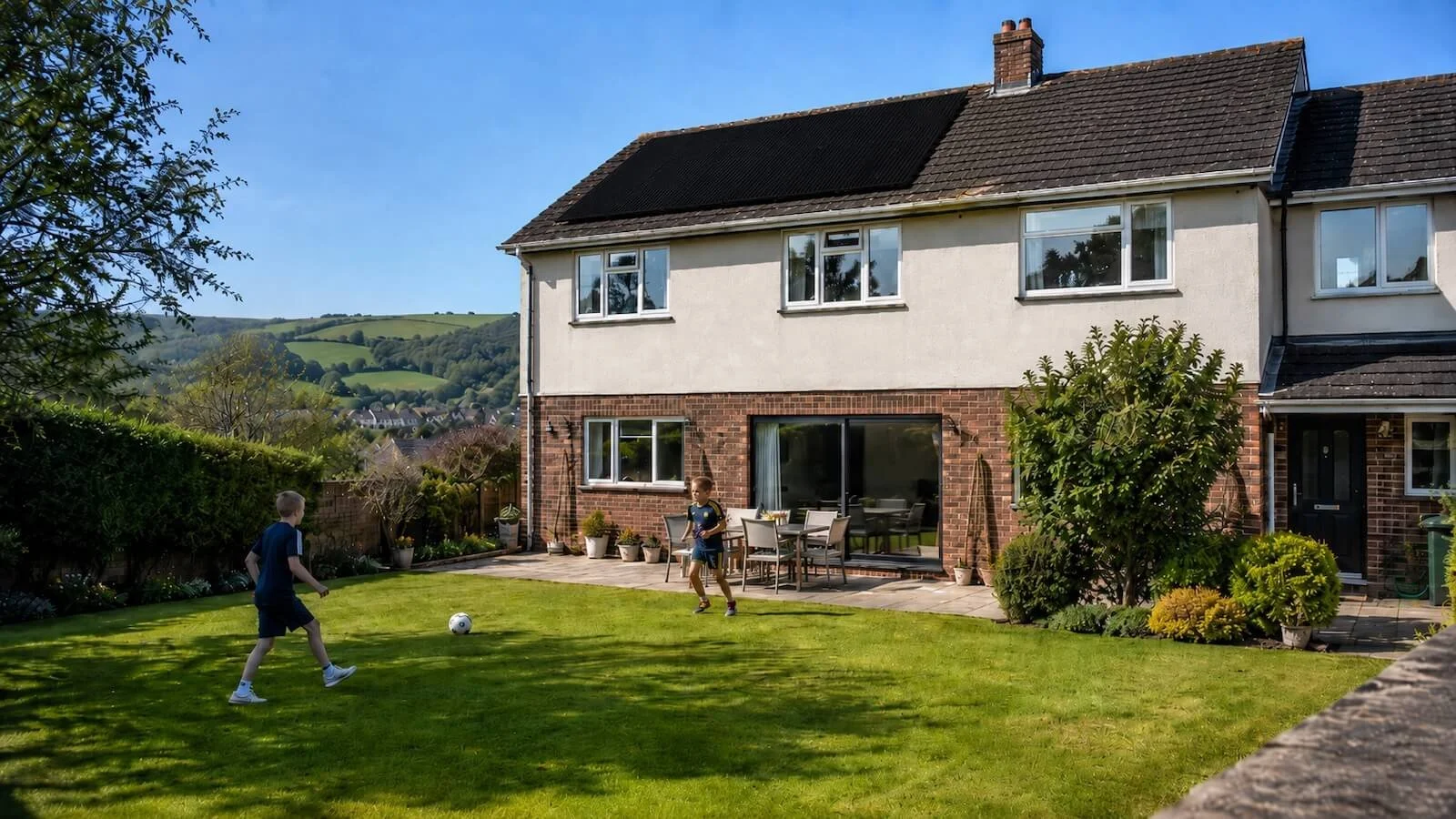
Electricity bills in south Devon are still painfully high in 2026, and more Newton Abbot homeowners than ever are looking for a straightforward way to take back control
Solar panels – ideally paired with a battery – are one of the few home upgrades that reliably cut bills for decades, add value to your property, and give you some protection from the next price-cap increase.
This page explains exactly what a solar installation in Newton Abbot costs, what it saves, how we design around a typical south Devon home, and how to get a fixed-price quote from the Simple Solar team.
No pushy sales. No surprise numbers on the final invoice. Just clear, honest answers from a local installer that has fitted hundreds of systems across Devon, Cornwall, Somerset and Dorset.

Table of ContentsTO SOLAR

Why Newton Abbot homes are a strong fit for solar
Solar panels do not need a blue sky or a hot summer day to work. They generate electricity from daylight, which means a panel on a Newton Abbot roof produces useful energy on an overcast November afternoon as well as in July.
Modern high-efficiency panels actually perform slightly better in the mild Devon climate than they do in very hot conditions – panel output drops as cell temperatures climb above about 25°C, so a breezy coast-side town like Newton Abbot has a natural advantage.
South-west England receives around 1,000 to 1,100 kWh of solar energy per square metre per year, which is broadly on par with parts of northern France and well ahead of most of Scotland. That is more than enough to make a residential installation pay back within a single-digit number of years on most homes, and then carry on generating, effectively for free, for another two decades or more.
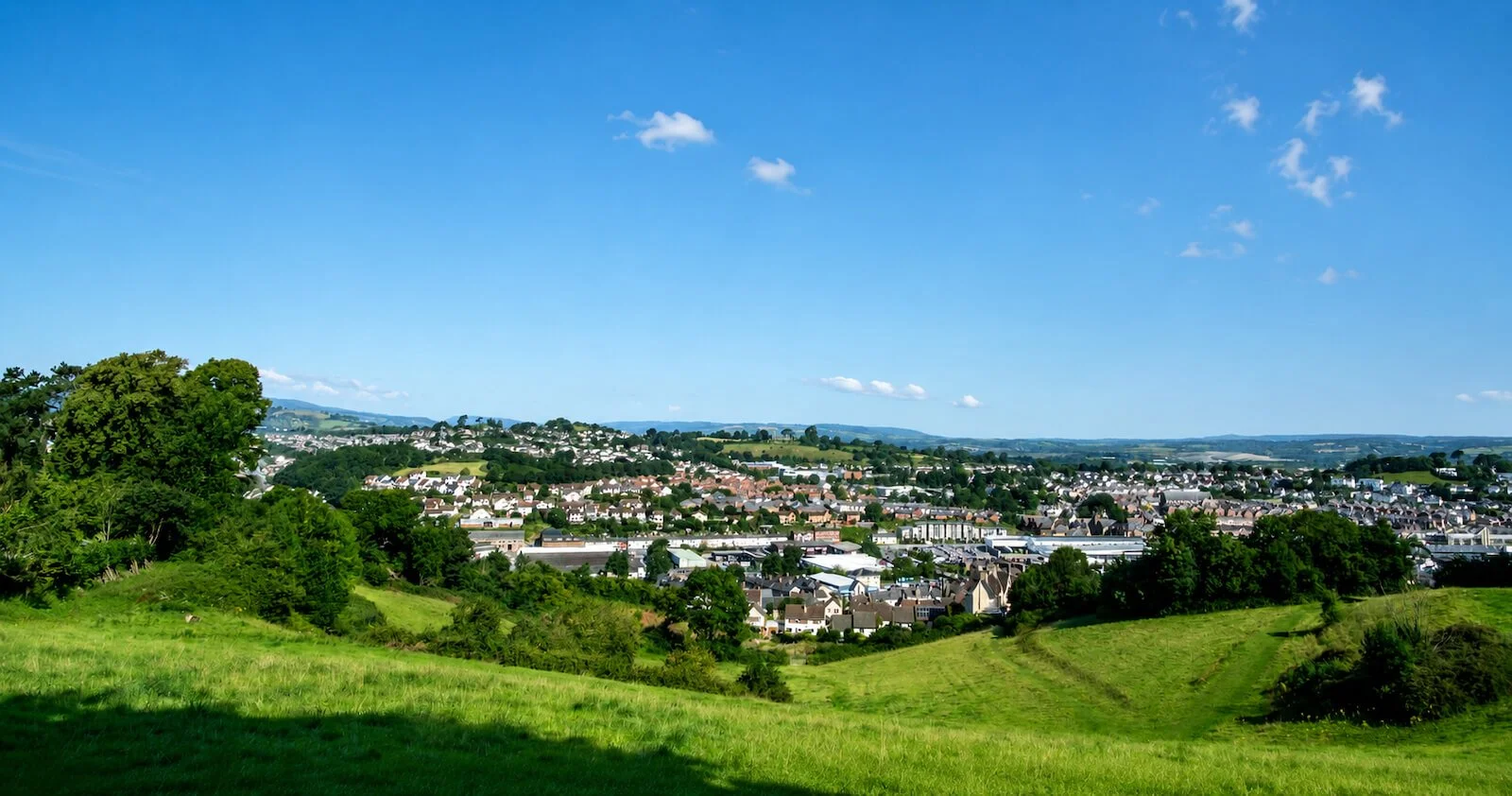
Newton Abbot also has a healthy mix of the kinds of property that suit solar well: 1930s to 1960s semis in Decoy, Milber and Highweek with generous south or south-east roof aspects; modern estates on the edges of Wolborough and Kingsteignton with uncluttered tiled roofs; Victorian terraces near the town centre where careful design can still deliver a useful 6 to 10-panel system; and barn conversions and farmhouses in the surrounding villages where roof space is rarely a constraint.
Each property type needs a slightly different approach, which is where a local surveyor who actually knows the area earns their keep.
Areas we cover near Newton Abbot
We are based in Plymouth but work right across south Devon. We regularly install in and around:
- Newton Abbot town
- Kingsteignton and Kingskerswell
- Bovey Tracey, Chudleigh and Chudleigh Knighton
- Ashburton, Buckfastleigh and Dartington
- Ipplepen, Denbury, Broadhempston and Widecombe-in-the-Moor
- Teignmouth and Shaldon
- The northern fringes of Torquay and Paignton
If you are in a village nearby that is not listed, do please get in touch – you’ll still be covered.
Typical roofs and system sizes we see locally
A Newton Abbot household with two or three occupants, a moderate daytime load and no electric car typically suits a 3 to 4 kWp system, about 6-8 panels.
A four-bedroom family home with heavier use, or one that also runs an electric car, often benefits from 5 to 6 kWp (10 to 12 panels). Larger detached properties and farmhouses regularly take 8 kWp and upwards.
Our rule of thumb: start with your annual electricity consumption in kWh (it is on your bill), divide by roughly 900 to 950 to get a kWp estimate for a Devon roof, and use that as a starting point.
The final design then depends on how much of your generation you are likely to use yourself, whether you plan to add a battery, and the practical limits of your roof. We will take you through all of that at the survey stage.
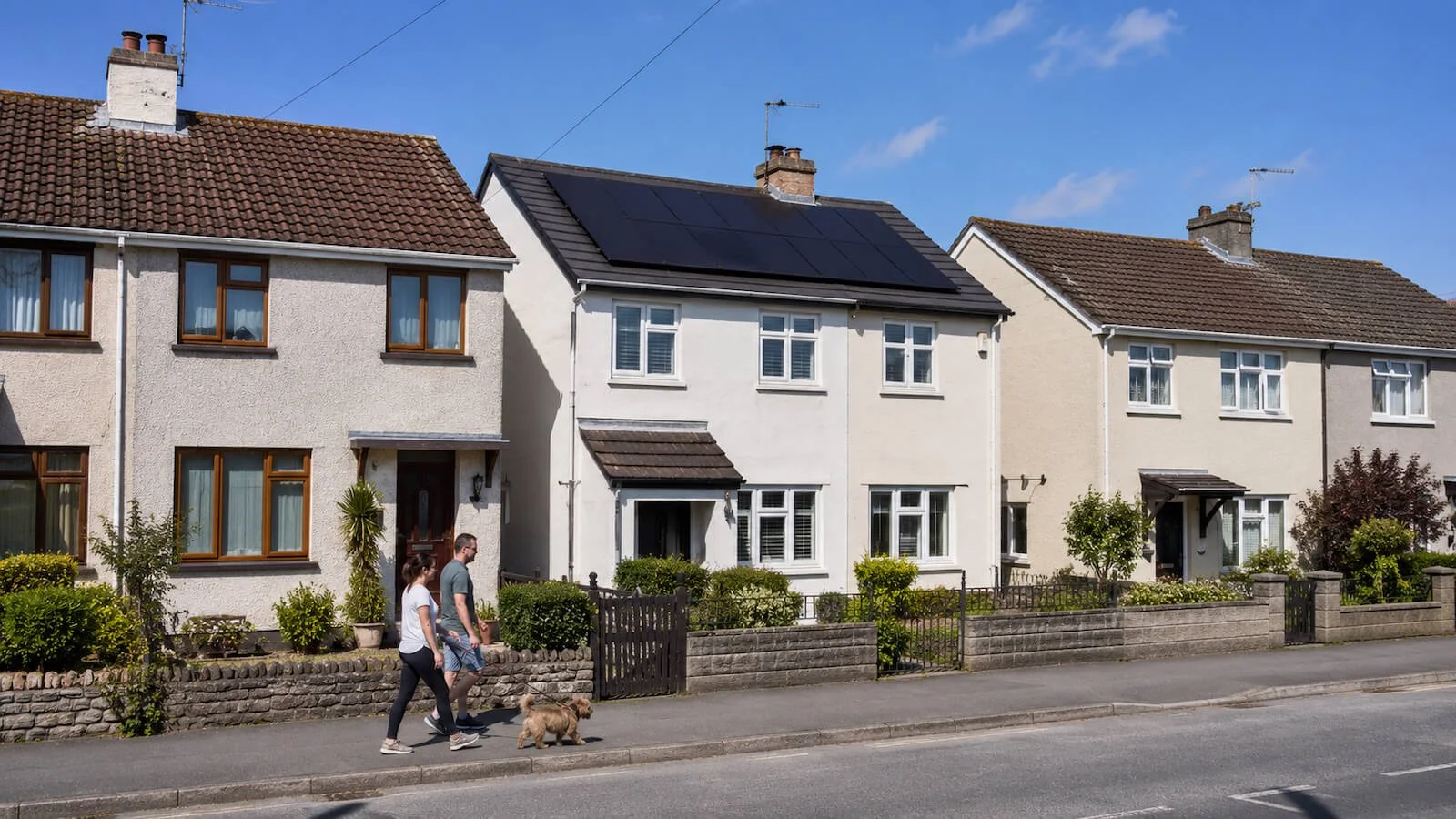
How much do solar panels cost in Newton Abbot?
There is no one-size-fits-all price for solar, but there are sensible ranges. The three things that move the number most are:
- System size – the number of panels and their total kWp rating.
- Battery size – whether you add storage, and what capacity.
- Property-specific factors – scaffolding access, roof type, whether your consumer unit needs upgrading, and how the cable run from roof to battery is going to work.
On top of those, every residential solar installation in Great Britain currently benefits from 0% VAT – a temporary relief set by HMRC that is written into the Value Added Tax (Installation of Energy-Saving Materials) Order 2022 and runs until 31 March 2027.
The relief applies automatically when you use the same company to supply and install the system, so there is no form to fill in and no grant to apply for.

The table below gives indicative figures for the system sizes we most commonly install on Newton Abbot homes.
| System size | Typical panels | Installed cost, solar only | Total annual return (saving + SEG) | Simple payback |
|---|---|---|---|---|
| 3 kWp | 6 panels | £4,500 | £410-£650 | 5-9 years |
| 4 kWp | 8 panels | £5,500 | £530-£850 | 6-9 years |
| 5 kWp | 10 panels | £6,000 | £650-£1,050 | 6-9 years |
| 6 kWp | 12 panels | £6,500 | £770-£1,250 | 5-8 years |
Every house is slightly different, so treat these as a starting point and come to us for a fixed quote.
Add a battery and you would typically spend £1,300 to £7,500 more depending on capacity (around 5 to 13.5 kWh for most households). A battery does not always shorten payback on paper, but it meaningfully increases your real-world saving because you use more of your own generation.
What the 0% VAT saving means for you
Until 31 March 2027, residential solar panel installations in Great Britain are zero-rated for VAT. After that date, the rate is due to revert to 5% unless the government extends the relief.
In practical terms: a £9,000 solar-and-battery installation today would cost you £9,450 at 5% VAT or £10,800 at 20% VAT. That is a £450 to £1,800 saving that you do not have to apply for; we simply do not charge VAT on qualifying residential installations.
It is worth being aware that the clock is ticking, though: if you are thinking about solar for 2027 or later, booking in during 2026 is likely to be cheaper than waiting.
Smart Export Guarantee payments
Once your system is switched on, you can sign up to a Smart Export Guarantee (SEG) tariff and get paid for every unit of electricity you send to the grid.
Every licensed UK electricity supplier with more than 150,000 customers has to offer an SEG tariff by law, but the rates they offer vary enormously.
- Leading fixed-rate SEG tariffs currently pay around 12p per kWh in 2026.
- Rates across the market range from roughly 4p to 15p depending on supplier and tariff type.
- Some time-of-use tariffs occasionally pay more during peak demand periods.
- You do not have to take your SEG tariff from the same supplier that imports your electricity.
- Your installation must be MCS-certified to register – every Simple Solar installation is.
Learn more about the Smart Export Guarantee (SEG) via Ofgem.
Is my Newton Abbot home suitable for solar?
Most Newton Abbot homes are. The important thing is designing around the roof you actually have — not the “perfect” roof installers use in brochures.
Over the past few years we have installed solar on everything from modern estate semis to older Devon farmhouses and barn conversions. During a free survey, we check the factors that genuinely affect output, payback and long-term reliability.
Roof orientation
South-facing roofs are ideal, but east, south-east, south-west and west-facing roofs can still perform extremely well — especially with battery storage and smart self-consumption.
Roof pitch
Somewhere between 20° and 50° tends to work best in the UK, although shallower and steeper roofs can still generate strong returns with the right design.
Shade levels
Chimneys, dormers, neighbouring trees and telephone poles can all affect output. Modern optimisers and micro-inverters handle partial shade far better than older systems.
Roof condition
Solar should only go onto a roof that is structurally sound. We check tiles, flashing and any visible signs of sagging or ageing before recommending installation.
Available roof space
Most modern panels require around 2m² of unshaded roof area each, although exact layouts vary depending on panel dimensions and spacing requirements.
Consumer unit suitability
Some older properties in and around Newton Abbot need consumer unit upgrades before solar can be safely connected. If that applies, we flag it clearly during quoting.
Shade, orientation and older Devon roofs
Homes across Newton Abbot often have quirks that make people assume solar will not work. Mature tree cover is common around Wolborough and Abbotsbury. 1930s semis frequently have dormers and awkward roof geometry. Farmhouses and barn conversions often combine slate, tile and sheet roofing across multiple elevations.
None of that automatically rules solar out. With panel-level optimisers or micro-inverters, shaded panels no longer drag down the performance of the entire system.
On split roofs, east-west arrays can actually align better with real household usage by producing more electricity in the morning and evening rather than peaking heavily at midday.
Planning permission for solar panels in Newton Abbot
For most Newton Abbot homes, you do not need planning permission to install solar panels.
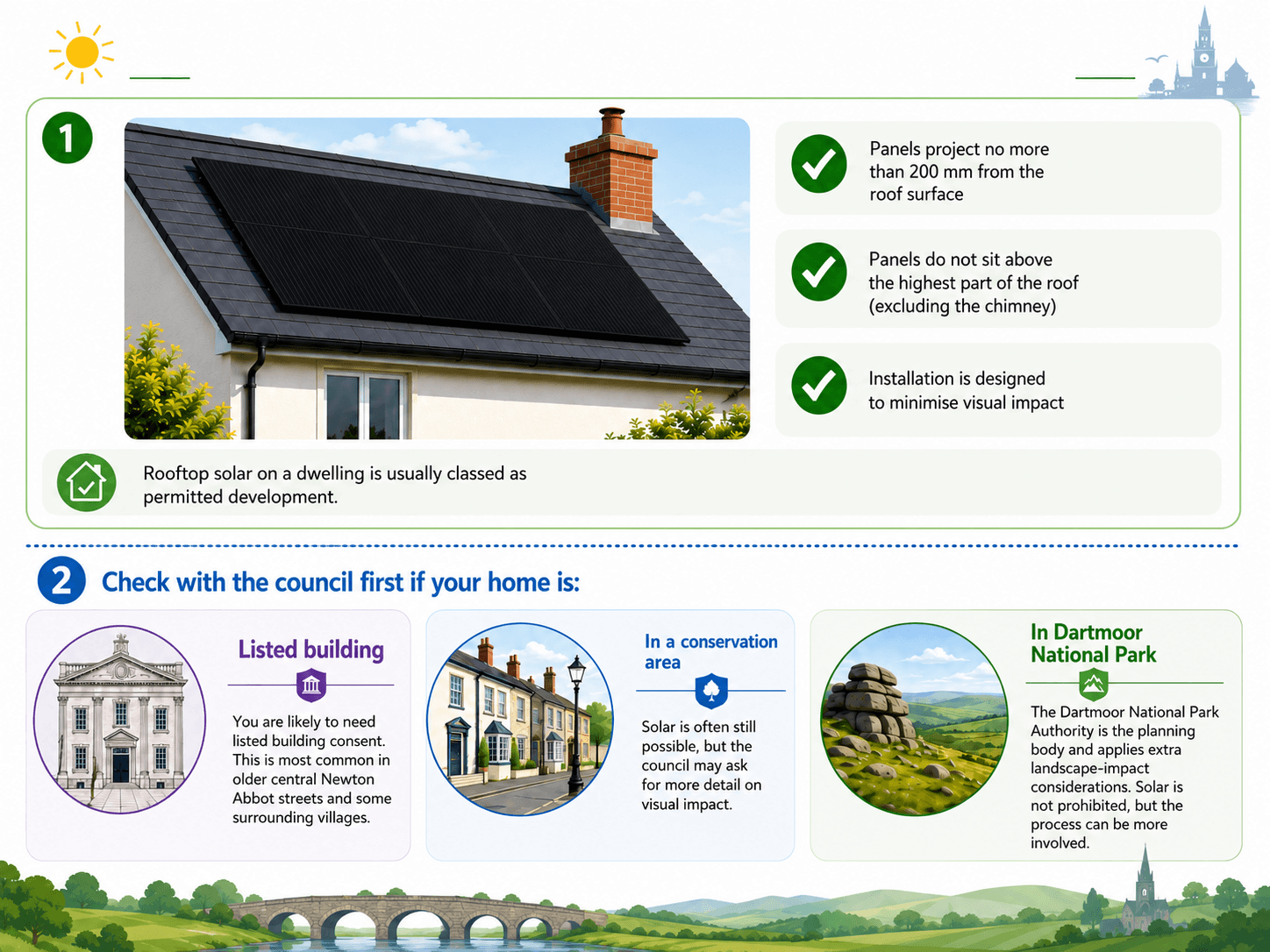
- Panels must not protrude more than 200 mm from the roof surface.
- Panels cannot extend above the highest part of the roof, excluding chimneys.
- The installation should minimise visual impact as far as reasonably practical.
Listed buildings
Listed homes often require listed building consent before solar installation, particularly across older central Newton Abbot streets and nearby villages.
Conservation areas
Solar is often still possible within conservation areas, but councils may request additional information regarding appearance and visibility.
Dartmoor National Park
Properties inside the National Park boundary are assessed under additional landscape-impact considerations by the Dartmoor National Park Authority.
If you are unsure which category your home falls into, Teignbridge District Council’s planning portal is the definitive source, and we are happy to point you in the right direction during the survey.
The equipment we install on Newton Abbot homes
A solar installation is only as good as the components inside it. We deliberately narrow our recommendations to products we trust on real Devon roofs — systems built for reliability, long-term performance and practical day-to-day use.
Solar panels & inverters
Our default recommendation is the SUNPOWER Performance panel range. These use shingled-cell technology that performs particularly well under partial shade — useful on Devon properties with chimneys, dormers and mature tree cover.
They also deliver strong output per square metre and come backed by a comprehensive 30-year manufacturer warranty covering Product, Performance and Service.
On the inverter side, we typically install hybrid inverters on battery-ready systems so storage can be added cleanly later if needed. For solar-only homes, a quality string inverter is often the better-value option.
Battery storage, EV charging & monitoring
For households wanting serious storage capacity and whole-home backup capability, our standard recommendation is the Tesla Powerwall 3 with 13.5 kWh of usable storage.
Smaller homes can scale storage differently using alternative UK-supported battery systems depending on budget, usage profile and available installation space.
We can also integrate a 7.4 kW EV charger during the same installation, allowing you to charge directly from solar generation or low-cost overnight tariffs.
Every system includes app-based monitoring so you can track generation, export, household usage and battery state-of-charge in real time.
Adding battery storage
A battery changes how a solar system behaves. Instead of exporting most of your daytime generation back to the grid, you store it and use it later when your household actually needs it.
A solar-only system typically allows you to self-consume around 30–45% of the electricity your panels generate. The rest is exported back to the grid for whatever your SEG tariff pays.
Add battery storage and that self-consumption figure usually rises to around 75–90%, because excess daytime generation is stored and then used during the evening and overnight.
Why off-peak tariffs matter
The economics become much stronger when battery storage is paired with a cheap overnight electricity tariff.
Tariffs like Octopus Go and Intelligent Octopus currently offer overnight electricity rates of roughly 7–10p per kWh. A hybrid inverter can automatically charge the battery overnight during that cheap window, then discharge it through the daytime when standard grid electricity is far more expensive.
In practical terms, the saving comes from the difference between cheap overnight electricity and daytime import rates — not from eliminating imports entirely.
Typical battery sizes we install
Usually suitable for a smaller property or a couple with relatively modest evening electricity use.
Common on family homes, especially where an EV charger or future heat pump installation is planned.
Larger homes sometimes use multiple batteries in series for extended backup capability and heavier overnight demand.
Solar panels and air source heat pumps
A growing number of Newton Abbot homeowners are pairing solar panels with an air source heat pump – and for good reason. Together, the two technologies turn your home into a coherent, all-electric system that cuts running costs across the whole year, adds serious resilience against future gas price rises, and meaningfully reduces your carbon footprint.
Why the combination works so well
The two work best when designed together. Solar is at its strongest from spring into autumn, which is exactly when your heat pump will draw the least electricity – meaning a large share of your summer generation goes straight into hot water and household use rather than being exported.
Spring and autumn shoulder seasons deliver useful overlap on space heating too. Add a battery, and you can shift even more of your daytime generation into the cooler evenings, getting more value from every panel on the roof.
Designing both systems together
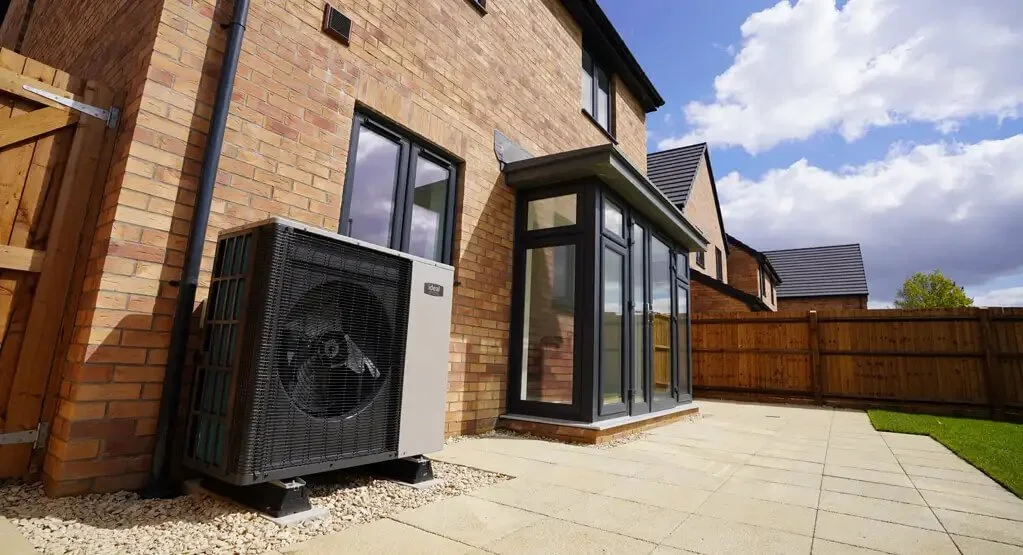
Simple Solar generally installs the Ideal Heating Logic HP290 air source heat pump across south Devon, though other makes and models are also available. If a heat pump is part of your plan, it is usually cheaper to have both systems designed together so that cabling, consumer unit capacity and hot water cylinder sizing are all considered up front.
In England and Wales, the Boiler Upgrade Scheme currently offers a £7,500 grant towards the cost of a qualifying air source heat pump installation – rising to £9,000 from July 2026 for homes currently heated by oil or LPG.
The grant is particularly relevant for off-grid properties in the surrounding villages such as Widecombe-in-the-Moor, Ashburton and Buckfastleigh.
The grant is applied by an MCS-certified installer like Simple Solar on your behalf; the scheme is administered by Ofgem on behalf of the Department for Energy Security and Net Zero.
Our Newton Abbot installation process, step by step
From first enquiry to a commissioned system, most Newton Abbot installations run on this timeline:
Free survey
We visit your home, assess roof, shade, consumption and any structural considerations, and explain what is realistic. There is no cost and no pressure.
Fixed-price design and quote
We send back a tailored design with a fixed price, an expected generation figure, a self-consumption estimate, and a SEG income projection. No hidden extras.
Contract and DNO application
If you choose to go ahead, we handle the Distribution Network Operator (DNO) application with Western Power Distribution / National Grid on your behalf. This is required for any system over 3.68 kW single-phase.
Installation
A typical 10-panel system is installed in one day. Scaffold goes up before we start and comes down once we are off the roof. We leave the site clean.
Handover and MCS certification
Once the system is commissioned, we issue your MCS certificate – the document you need to register for SEG – and walk you through the monitoring app.
Ongoing support
If anything ever flags on the monitoring side, or you are thinking of adding a battery or EV charger later, we are a phone call away.
Grants, finance and making solar affordable
There are several ways to reduce the upfront cost of going solar in 2026 — from VAT relief and export payments to government-backed schemes and spread-the-cost finance.
The honest picture in 2026
Most homeowners are no longer relying on one single grant to make solar work financially. Instead, affordability comes from a combination of lower VAT, ongoing export income, reduced electricity bills and, increasingly, finance or low-interest lending options.
The right combination depends on the property, the technology being installed, and whether you are adding extras like battery storage or a heat pump at the same time.
VAT relief & export income
Residential solar and battery installations are currently zero-rated for VAT in Great Britain. The relief is applied automatically by us and currently runs until 31 March 2027.
Alongside that, the Smart Export Guarantee (SEG) pays you for surplus electricity exported back to the grid. Standard fixed tariffs in 2026 typically range between 4p and 15p per kWh, with some time-of-use tariffs paying more during peak demand periods.
Warm Homes Plan & heat pump grants
The UK Government’s £15 billion Warm Homes Plan was announced in January 2026 and is expected to include low-interest or 0% loans for solar panels, batteries and heat pumps alongside existing grant programmes.
At the time of writing, the final eligibility rules and application routes are still being confirmed. We will update this page once GOV.UK publishes the definitive guidance.
Separately, the Boiler Upgrade Scheme currently offers a £7,500 grant for qualifying air source and ground source heat pump installations in England and Wales — increasing to £9,000 from July 2026 for homes heated by oil or LPG.
Spread-the-cost finance
Simple Solar offers finance through Phoenix Financial Consultants, an FCA-authorised credit broker. Finance is subject to status and credit checks, but for many households it allows the monthly saving on electricity to offset a meaningful portion of the repayment cost.
If you are comparing finance against paying upfront, the important thing is to look at the total long-term energy saving across the lifespan of the system — not just the initial install figure.
Flexible spread-the-cost options available through Phoenix Financial Consultants.
Explore finance optionsFrequently asked questions
Straight answers to the questions Newton Abbot homeowners ask most often before going solar.
01 How much do solar panels cost in Newton Abbot?
For most Newton Abbot homes, a standalone solar installation costs between roughly £4,500 and £6,500 depending on system size, with 0% VAT already applied. Adding a battery typically adds another £3,500 to £8,000. The cost table earlier on this page gives ranges for the most common system sizes. Ask us for a fixed quote for your exact home.
02 How long do solar panels last?
Quality panels are built for 25-40 years of service life, depending on the product and manufacturer warranty. Inverters typically last 10-15 years and may be replaced once in the panels' lifetime. Batteries carry their own cycle-life warranties, usually around 10 years for the most common lithium-iron-phosphate units.
03 Do solar panels work on cloudy days in Devon?
Yes. Solar panels generate from daylight, not just direct sunshine. Output is lower on overcast days, but not zero, and modern high-efficiency panels still produce meaningful energy through a typical Devon winter. Annual generation figures already account for cloud, rain and short December days; you do not need a sunny climate for solar to pay back.
04 Do I need planning permission for solar panels in Newton Abbot?
In most cases, no. Rooftop solar on a dwelling is generally classed as permitted development, subject to the usual conditions on projection and roof height. Exceptions include listed buildings (where listed building consent is typically required), conservation areas and properties inside Dartmoor National Park. Teignbridge District Council's planning portal is the definitive source if you are unsure.
05 How many solar panels do I need for a 3-bedroom house?
A typical three-bedroom Newton Abbot home suits a 3-5 kWp system – around 6 to 10 panels. The right number depends on your annual consumption, how much of your generation you are likely to use yourself, and how much unshaded roof you have. The survey pins it down precisely.
06 Can I add a battery or EV charger to my solar system later?
Yes. If you know you may want a battery or EV charger in future, we can specify a hybrid inverter and run the necessary cabling on day one, so that adding the kit later is a straightforward retrofit. Adding both on day one is usually more cost-effective overall, because it avoids a second scaffold and second DNO application.
07 Are there grants available for solar panels in 2026?
The main universal saving is the 0% VAT rate on residential solar and battery installations, which runs until 31 March 2027 and is applied automatically. The UK Government's Warm Homes Plan (announced January 2026) is expected to include 0% or low-interest loans for solar, batteries and heat pumps, but full eligibility and application routes are still being finalised. Some households may qualify for specific schemes – we will flag anything relevant during the quote process.
08 How much can I earn from the Smart Export Guarantee?
It depends on which tariff you sign up to and how much you export. On a standard 4 kWp system without a battery, exports are typically around 2,000-2,500 kWh per year. At a fixed SEG rate of 12p per kWh, that works out at £240-£300 a year in export income. Add a battery and your export volume falls, but your bill savings rise by more, so the overall financial result improves.
09 Will solar panels affect my home's value?
Most evidence points in the direction of solar being neutral-to-positive on property value, particularly as buyers become more conscious of running costs. A well-installed, MCS-certified system with a live SEG tariff is a straightforward plus for most houses. Poorly installed or unwarranted systems can occasionally create friction – a good reason to choose an accredited local installer rather than a national call-centre operation.
AUTHOR