
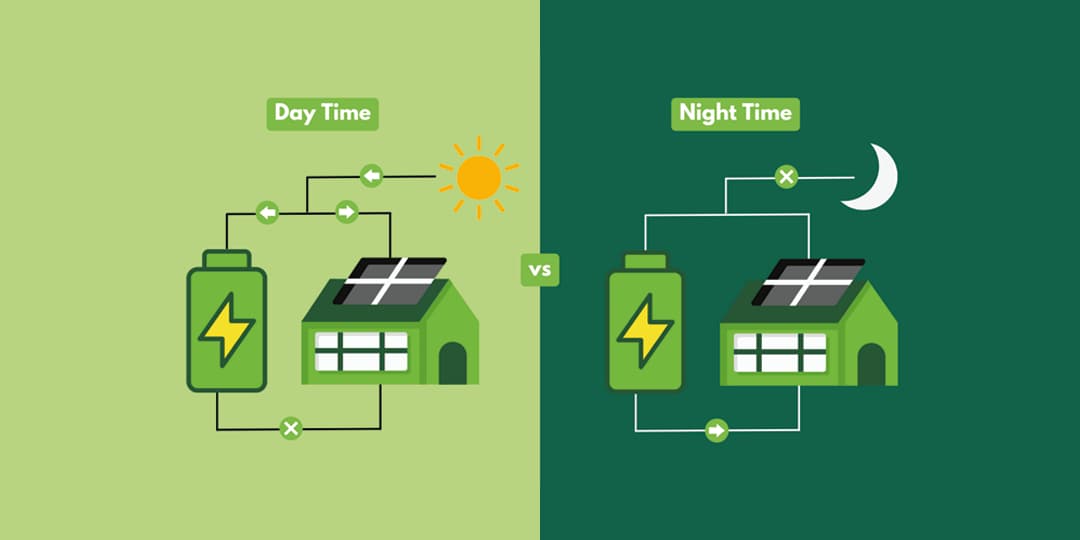
Solar without a battery is only half the story
Your panels generate most when the sun is up. But many households use the most electricity later — cooking, heating controls, lighting, entertainment, hot water, and EV charging.
Without a battery, any unused solar is exported to the grid. With a battery, that energy is stored and used when you actually need it.
Use your own energy after sunset
A battery stores surplus solar generated during the day and releases it in the evening and overnight. That means your home can run on your own solar for longer — not just during sunny hours.

Control your costs, not just your consumption
Battery storage reduces how much electricity you buy from the grid, especially in the evening when prices are often higher.
With smart controls, you can also choose how your system behaves:
- Prioritise self-use (use your own solar first)
- Charge strategically (use off-peak rates if you’re on a smart tariff)
- Export by choice (when it suits you)
We’ll configure this based on your tariff, habits, and goals — “set and forget” or fully optimised.
Backup power (optional, but brilliant)
Some battery systems can be configured to keep essential circuits running during an outage — things like lights, Wi-Fi, fridge/freezer, and key sockets.
Backup isn’t automatic on every battery. It depends on the battery/inverter setup and whether you want a dedicated “essential loads” circuit. If backup matters to you, we design for it from the start.
Add it to existing solar, or build it in from day one
Already have solar? In many cases, battery storage can be added later — we’ll check compatibility at survey and recommend the cleanest route.
Planning a new solar install? We can design solar + battery together, which is usually the most seamless option.
Either way, we aim for a system that’s upgrade-friendly, so you’re not boxed in later.
Right size = best results
Battery storage isn’t one-size-fits-all. We size it around:
- Your evening usage
- How much solar you export
- Whether you have (or plan) an EV charger or heat pump
- Whether you want backup capability
From smaller systems through to large-capacity setups for higher-demand properties, we’ll recommend what actually makes sense — and what doesn’t.
The bottom line
Solar starts the job. Batteries finish it.
Battery storage helps you use more of the energy you generate, reduce grid reliance, and run your property with more stability and control — day and night.
Want a free, fixed battery quote?
We’ll recommend the right size, show you the numbers clearly, and handle everything from survey to install.
Click Get a quote for a free, fixed-price quote, or call 01752 916 013 to speak with the team.