
PLUG-IN SOLAR BECOMES LEGAL THIS MONTH: HOW DOES IT COMPARE WITH ROOFTOP SOLAR?
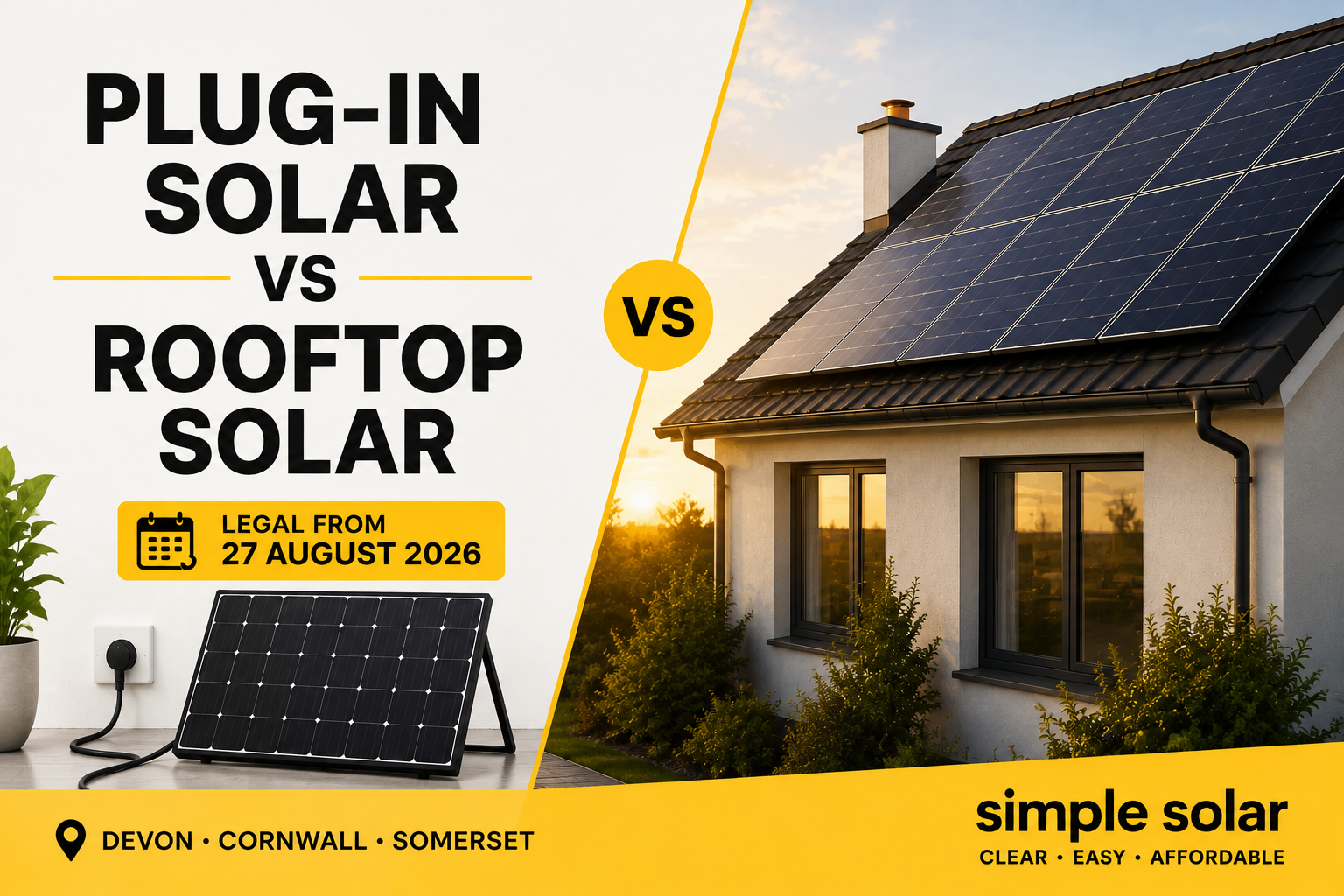
From 27 August 2026, households in England, Scotland and Wales will be legally permitted to use compliant plug-in solar systems connected through a standard mains socket.
The change comes through new regulations (SI 2026/848) signed in July, which remove a long-standing rule that prevented generation equipment from being connected through a plug and socket.
The new rules create a legal route for compliant plug-in systems while limiting their generation capacity.
The government first announced the move in March 2026, with the aim of opening solar up to renters and flat dwellers: people who have never had a practical route to generating their own power. It is a welcome step, and one the solar industry has been watching closely.
But how does plug-in solar compare with a traditional rooftop installation? And what should homeowners across Devon, Cornwall and Somerset make of it?
Below, we explain what the new rules allow, what they leave out, and where each technology makes sense.
What is plug-in solar?
Plug-in solar, sometimes called ‘balcony’ solar, is a scaled-down version of a rooftop array: typically one or two panels connected to a small microinverter, mounted on a balcony, wall or garden frame, and plugged into an ordinary 13 A socket.
The electricity it generates feeds whatever is running in the home at that moment, reducing the amount drawn from the grid.
What the new rules allow, and what they leave out
SI 2026/848 comes into force on 27 August 2026. From that date, a compliant plug-in solar product can legally be connected through a standard socket, provided it meets some strict conditions.
The device must be a complete, approved product tested against the government’s Interim Product Specification, with an approved three-pin plug and a microinverter limited to 800W of output.
It must be plugged directly into a fixed wall socket, never an extension lead or adaptor. The householder will also have to register the device with their local electricity network operator under the G98 connection arrangements. The simplified registration process for plug-in solar is being developed by network operators and the Energy Networks Association.
Just as important is what the rules exclude:
Systems with built-in battery storage sit outside the plug-in route altogether: the exclusion is written into the legal definition itself.
Plug-in devices also switch themselves off during a power cut, a safety feature known as anti-islanding, so they cannot keep the lights on when the grid goes down.
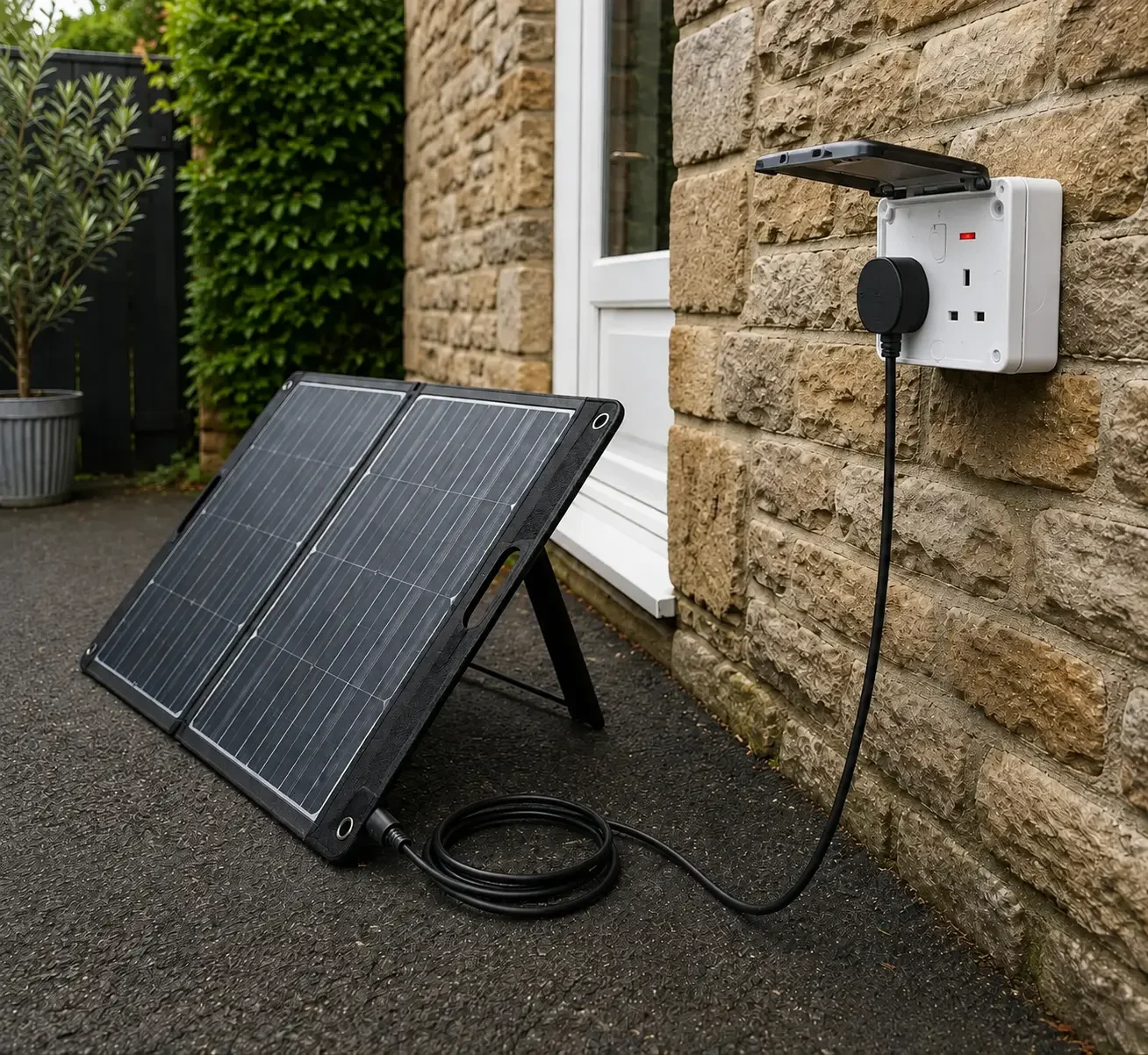
Until the new regulations take effect on 27 August, plug-in solar devices cannot lawfully be used in Great Britain through a standard mains socket.
27 August 2026 is the key date.
Plug-in solar vs rooftop solar: how they compare
On paper the two technologies do the same job. In practice they are built for different homes, different budgets and different results.
Not permitted under the plug-in route
Fully compatible; systems can be designed around storage such as the Tesla Powerwall 3
Not normally eligible; SEG suppliers typically require MCS or equivalent certification
Normally eligible with MCS or equivalent certification and compliant export metering
None; devices must shut down when the grid goes down
Available when paired with a compatible battery system
The safety debate
Safety is where opinion in the industry divides, and it is worth being straightforward about both sides.
The government’s position is grounded in testing, in the form of a 96-page electrical safety study commissioned by the Department for Energy Security and Net Zero, published in June 2026.
The study found that representative plug-in PV systems could operate safely within the conditions tested on UK domestic circuits, without modifications to fixed wiring, consumer units or protective devices.
Ministers have been clear, though, that product standards and installation guidance must be followed, and that official guidance will set out when an electrician should inspect an older or potentially unsuitable installation.
Electrical bodies have urged more caution. The Institution of Engineering and Technology (IET) has pointed out that the types of RCD historically fitted in British homes do not meet the minimum requirements for plug-in solar inverters, that not all protective devices are designed for power flowing in both directions, and that the UK’s distinctive approach to wiring socket circuits was never designed with generation in mind.
Its view is that an assessment by a competent electrician is the only reliable way to establish whether a home’s wiring is ready for generation. The IET has also reported that only 30% of adults had had their household electrics checked by a qualified electrician within the previous decade.
Consumers should check that any product has completed the required UK testing and registration process rather than assuming a European-approved product automatically complies with the new British requirements.
None of this makes plug-in solar unsafe as a concept. It does mean the risk sits in the details: older wiring, uncertified products and the temptation to improvise. Those are exactly the areas where professional design, certified equipment and proper testing earn their keep.
What it means for homeowners in Devon, Cornwall and Somerset
For renters and flat dwellers, plug-in solar is good news. It gives people who could never arrange a rooftop installation a legal, low-cost way into solar power, and the industry should welcome it.
For homeowners with a suitable roof, a professionally installed rooftop solar system, offers a very different proposition. An 800W plug-in device can trim daytime consumption; a properly sized rooftop system changes the shape of the household’s energy bill.
Rooftop solar generates several times more electricity, qualifies for export payments, and works with battery storage such as the Tesla Powerwall 3 to cover the evenings, and comes with the certification, warranties and consumer protection that a self-installed product cannot offer.
If rooftop solar is the right option for your home, the next decision is which panels to choose. Our Aiko Neostar vs SunPower M Class comparison looks at two of the premium panels we install, including efficiency, construction, warranty and which suits different homes.
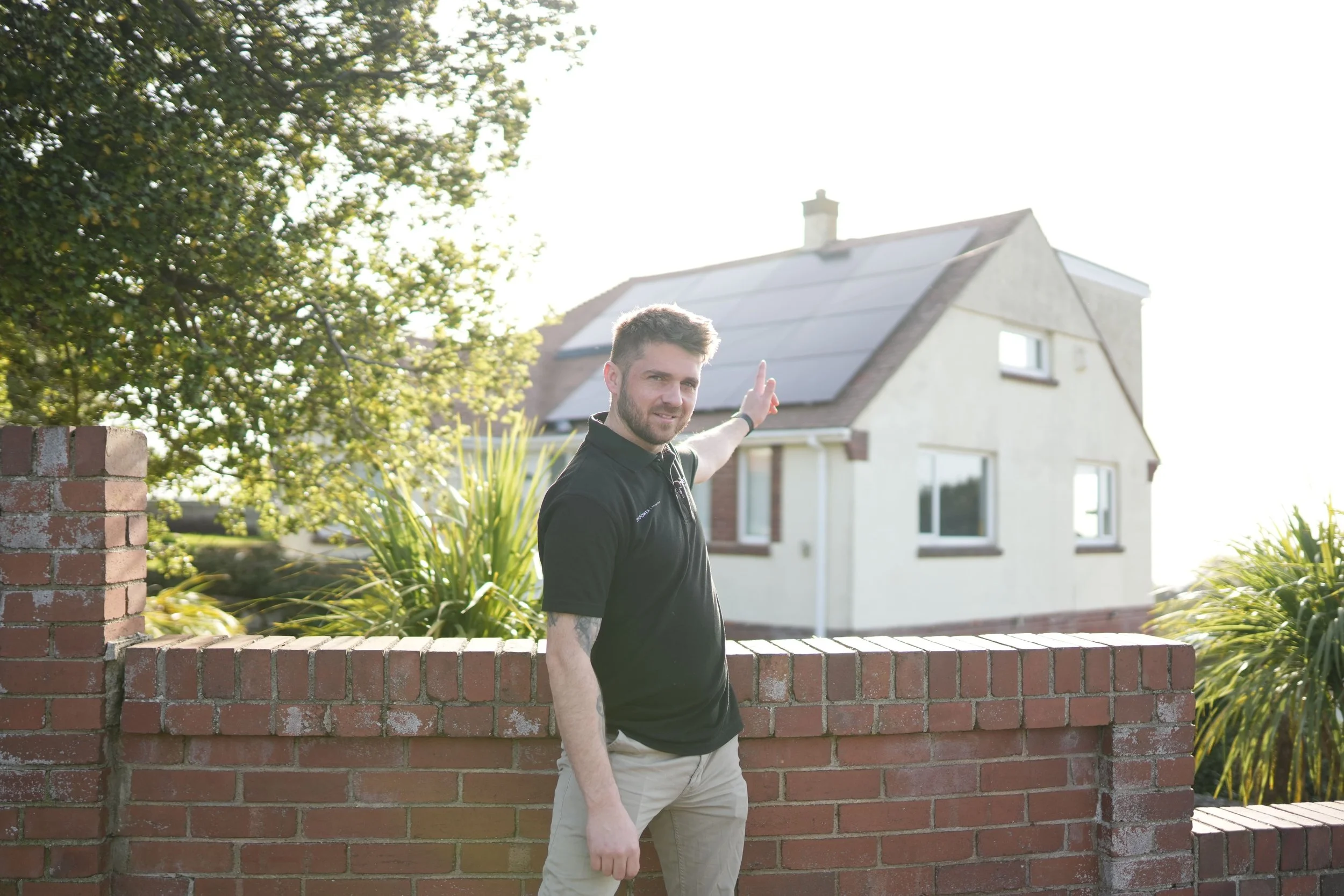
"Plug-in solar is a welcome way in for renters, but it is a different product doing a different job. For a homeowner with a suitable roof, a properly designed and certified rooftop system will generate a lot more power, earn export payments, and pay back in a way an 800W device simply cannot," says Dan Barnes, Director at Simple Solar.
Our view is that the two are not really competitors. Plug-in solar extends solar power to homes that could not have it before; rooftop solar remains the serious investment for those who can.
If you own your home in Devon, Cornwall or Somerset and are weighing up your options, a free, no-obligation survey will tell you exactly what your roof could deliver.
